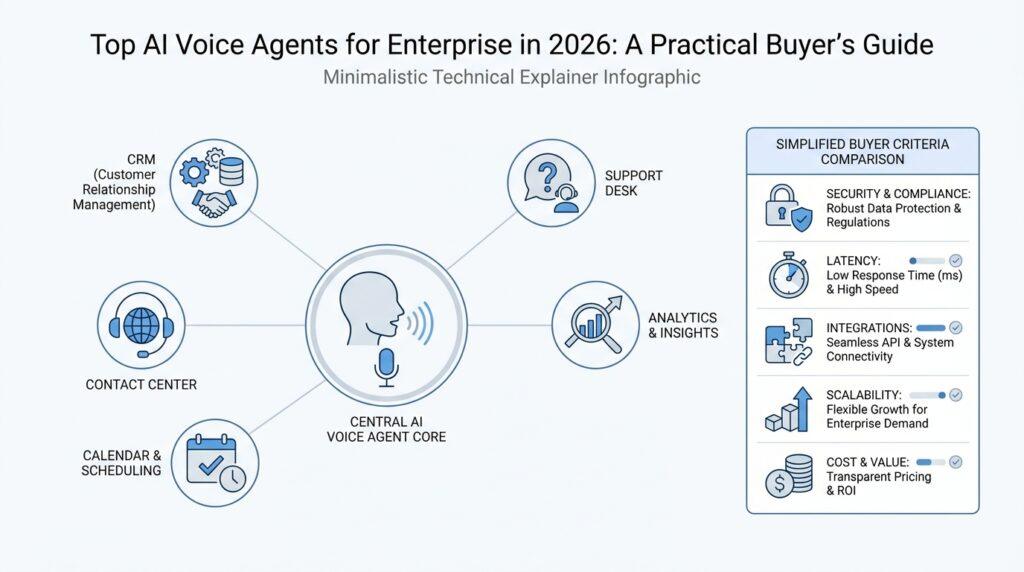
Define Your Target Use Cases
Before we compare features, we need to answer a simpler question: what work do you want the AI voice agent to do? A use case is just one specific job, like answering repeat calls, booking appointments, or qualifying a lead, rather than the vague goal of improving phone support. That distinction matters because enterprise voice AI tends to work best when the conversation has a clear purpose and a clear outcome. If you cannot describe the call in one sentence, you are probably still shopping too early. What are the best AI voice agent use cases for an enterprise? Start by naming the conversation, not the vendor.
The easiest first candidates are the calls your team hears over and over again. Think billing questions, order status, account lookups, FAQs, and other routine requests where callers mostly need a fast answer and a clean handoff when something unusual appears. Twilio describes these as self-service and virtual-agent workflows, and Google Cloud positions conversational AI for contact centers and agent support, which matches the same pattern: high volume, repetitive, and easy to standardize. In plain language, if a call feels like the same script with different names and dates, AI voice agents can usually carry a lot of the load.
Next, look for conversations with a simple transaction at the end. Appointment scheduling, rescheduling, cancellations, lead qualification, and proactive reminders are strong fits because the agent can ask a few structured questions, update a calendar or CRM, and either finish the task or pass the caller along with context. Twilio’s recent examples and customer stories show these exact workflows in healthcare and lead generation, and AWS case studies show similar appointment-scheduling automation in contact centers. The key is that the AI voice agent should be doing a real job, not just sounding friendly.
The opposite of a good first use case is a conversation that depends on judgment, emotion, or messy exceptions. If the caller is upset, the policy is complicated, or the answer could create legal, financial, or clinical risk, we want a human in the loop from the start. That is why the strongest enterprise AI voice agents usually combine automation with agent escalation, so the system handles the routine part and hands off the hard part with full context. In other words, the best design is not replace everyone; it is remove the repetitive work so people can focus where they matter most.
From here, we can score each candidate use case by four simple questions: how often it happens, how much time it saves, how safely it can be automated, and how easily it can connect to the systems that already run the business. A narrow first win is usually better than a grand launch, because it lets the team learn, measure, and earn trust before expanding. If one call type happens all day long, follows a predictable path, and ends in a calendar, ticket, or CRM update, that is usually the lane to test first. Once we know that lane, choosing among AI voice agents becomes much more concrete, because we are no longer buying abstract AI, we are buying help for a specific conversation.
Compare Latency and Voice Quality
Picture two AI voice agents answering the same enterprise call. One responds so quickly that the caller barely notices the handoff; the other pauses long enough that the silence starts to feel awkward. That pause is latency, the delay between the end of the caller’s speech and the start of the agent’s response, and it matters because human conversation depends on fast turn-taking. Research on conversational systems notes that long response delays and frequent interruptions are a core problem, so a voice agent can sound intelligent on paper and still feel clumsy in the moment. If you have ever wondered, “Why does one AI voice agent feel smoother than another even when they answer correctly?”, this is usually where the answer begins.
But speed is only half the story. Voice quality is the other half, and it covers how natural, clear, and pleasant the synthetic voice sounds to a human listener. The International Telecommunication Union warns that Mean Opinion Score, or MOS, can be easy to misunderstand because it may refer to listening quality, talking quality, or conversational quality, not one single thing. That is why ITU-T P.804 breaks conversational speech quality into listening, speaking, and interaction phases, which maps neatly to enterprise voice AI: we are not only judging the sound of the voice, but also how it behaves in the back-and-forth. In practice, a voice agent can be fast yet grating, or beautiful yet sluggish, and those are two very different buying problems.
The cleanest comparison is to test both on the same call flow, under the same conditions, and score them separately. For latency, measure the full path from the caller’s final word to the agent’s first audible response, because that is what the caller experiences, not the internal timing inside the model. For voice quality, use a listening test or an objective predictor such as ITU-T P.863, which estimates overall speech quality across narrowband through fullband telecommunication scenarios. That distinction matters because a system can sound polished in a lab test and still feel slow in a real conversation, or it can reply quickly but produce audio that listeners rate poorly. Comparing AI voice agents without splitting these two scores is like judging a car by both speed and comfort in one number and hoping the result tells the whole story.
When you put latency and voice quality side by side, the tradeoff becomes easier to read. In a transactional workflow like appointment scheduling or order status, lower latency often wins because callers want momentum and clear progress. In a brand-sensitive or high-trust workflow, stronger voice quality often matters more because a warm, stable voice can make the interaction feel safer and more human. The best enterprise voice AI does not force you to choose one forever; it gives you enough responsiveness to keep the conversation moving and enough vocal polish to keep people comfortable while they stay on the line. That is the real comparison we want to make before we look at reliability, escalation, and integration.
Check CRM and Telephony Integrations
Once the voice sounds right and the pauses feel natural, the next question is whether the agent can actually live inside your existing systems. That is where CRM and telephony integrations matter, because an AI voice agent is only useful when it can see the customer record, write back call notes, and work through the phone setup your team already trusts. Without those connections, even a polished agent becomes a polite stranger with no memory. When you are comparing AI voice agents, this is the point where the buying decision moves from “Does it sound good?” to “Can it do the job inside our stack?”
Think of the CRM as the agent’s notebook and the telephony layer as its phone line. A CRM, or customer relationship management system, stores the history that helps a team recognize who is calling, what happened last time, and what should happen next. Telephony is the system that handles calling, routing, numbers, and the handoff between people and machines. The best AI voice agents do not treat these as side features; they use CRM and telephony integrations to make each conversation feel continuous instead of starting from zero every time. How do you know whether a voice agent will fit your CRM and telephony stack? You start by asking whether it can read, listen, and write in the same places your team already uses.
The CRM side is often where the real business value shows up first. If the agent can identify a caller, open the right account, and update the contact record after the call, your team gets context without extra clicking or copy-pasting. That might mean logging the reason for the call, tagging the outcome, creating a follow-up task, or updating a field that tells sales or support what happened. In practice, strong AI voice agent integrations turn a live conversation into clean data, which keeps the next human from having to guess what the last conversation was about.
Telephony integration matters just as much, because the phone system is where the experience either flows or breaks. You want the agent to answer on the right number, route calls correctly, transfer to a human without losing context, and handle voicemail or after-hours rules in a way that matches your business. If your enterprise already uses a contact center platform or a cloud phone system, the AI voice agent should fit that environment rather than force you to rebuild it. This is also where reliability starts to show its face, because a good-looking demo can still fail if the handoff between the voice agent and the phone system is awkward, slow, or brittle.
The safest way to test CRM and telephony integrations is to follow one call from start to finish and watch every system touchpoint. The agent should recognize the caller, pull the right record, complete the conversation, send the outcome back to the CRM, and route any escalation with the full story attached. If you see duplicate records, missing notes, or transfers that make the caller repeat everything, the integration is not ready yet, no matter how impressive the voice sounds. That kind of friction is easy to miss in a demo and hard to forgive in production.
It also helps to separate surface-level connections from true workflow integration. A surface-level connection means the vendor can link to a CRM or phone platform in name, but still requires manual cleanup, custom workarounds, or fragile middleware. True integration means the AI voice agent can support the actual business process, from authentication to logging to follow-up, with the least possible human correction. That distinction is why enterprise buyers should ask not only which platforms are supported, but what the agent can do inside those platforms on a normal day.
When you look at AI voice agents through this lens, the decision becomes much clearer. You are not choosing between abstract features; you are choosing which system can carry a conversation through the tools your team depends on. If the CRM and telephony integrations are strong, the agent can save time without creating cleanup work, and that is the kind of payoff that makes the rest of the evaluation worth doing. From here, the next thing to examine is what happens when the agent cannot finish the job on its own and needs to hand off cleanly to a human.
Review Security and Compliance Controls
Now that the agent can reach your CRM and phone system, the next question gets more serious: what happens to the conversation after it starts touching real customer data? That is where security and compliance controls move from a checkbox to a business requirement. In enterprise AI voice agents, we want to know who can hear the call, where the transcript goes, how long it stays there, and whether the system behaves in a way that matches your legal and internal rules. NIST treats secure, resilient behavior as a core trait of trustworthy AI, and its security control catalog includes access control, audit and accountability, incident response, and system communications protection for exactly this kind of risk review.
The first thing to inspect is access control, which means making sure only the right people and systems can see or change sensitive call data. Think of it like a building with different keys for the lobby, the records room, and the vault; not everyone should walk everywhere. In practice, that means role-based access, strong authentication, and logs that show who opened a record, changed a setting, or exported a transcript. NIST’s control framework treats access control and audit/accountability as separate families for a reason: one limits entry, and the other leaves a trail when someone enters.
Then we look at data handling, because voice data can pile up fast. A strong enterprise voice AI should collect only what it needs, store it only as long as it needs it, and protect it while it moves and while it rests in storage. Under GDPR Article 25, organizations are expected to build data protection in from the start and, by default, process only the personal data needed for each purpose; that fits voice workflows where transcripts, recordings, and metadata can easily become more than the business truly needs. If the vendor uses techniques like pseudonymization, which means replacing direct identifiers with stand-ins, that is a good sign that privacy was designed into the system rather than added later.
What if the calls involve regulated information, like health data? Then the contract matters as much as the technology. HHS says covered entities and business associates need written agreements that set permitted uses and disclosures, require appropriate safeguards, require breach reporting, and require return or destruction of protected health information when the relationship ends. In plain language, if an AI voice agent might handle protected health information, you should ask whether the vendor will sign a business associate agreement, or BAA, because that agreement is part of how HIPAA compliance is maintained.
The best vendors do not stop at promises; they show evidence. NIST’s control-assessment guidance exists so organizations can verify that controls are actually implemented, meet their intended objectives, and produce the security and privacy outcomes they claim. That is why it helps to ask how often the vendor tests access controls, reviews logs, validates retention settings, and exercises incident response for events like unauthorized access or data leakage. A polished demo can sound reassuring, but a tested control is what keeps AI voice agents safe when the call volume rises and the pressure is real.
If your team operates across regions, you should also ask how the vendor handles geography and deletion. A voice agent that stores recordings in one country, processes them in another, and keeps backups somewhere else can create compliance headaches if nobody can explain the path clearly. The safer vendors can tell you where data lives, who can access it, how quickly it is deleted, and what happens when a caller asks for their data to be corrected or removed. Once those answers are clear, you are no longer guessing about security and compliance controls; you are comparing AI voice agents on whether they can protect the conversation from the first hello to the final archive.
Assess Analytics and Observability Tools
By the time we reach analytics and observability tools, the question is no longer whether the voice agent can answer a call. The real question is whether we can see what it is doing well, where it hesitates, and where it quietly breaks down. Observability means understanding a system from the outside through signals like traces, metrics, and logs, and NIST has recently emphasized that post-deployment monitoring for AI systems is a crucial but still fragmented practice. If you are asking, “What should I look for in analytics and observability tools for AI voice agents?”, this is where the answer starts.
A good place to begin is with the difference between a dashboard and a diagnosis. Metrics are the numbers that tell us what is happening in aggregate, such as volume, timing, or error rates, while traces and logs help us follow one specific request or call through the system step by step. OpenTelemetry, the vendor-neutral observability framework, treats traces, metrics, and logs as the core signals, and it even encourages correlating logs with trace and span IDs so teams can connect one event to the rest of the conversation path. In plain language, the best analytics and observability tools do not just count calls; they help us explain why a call went wrong.
For voice agents, the most valuable signals are the ones that mirror the caller’s experience. Twilio’s Voice Insights focuses on call quality analytics and aggregation, while its Conversation Relay Insights surfaces end-to-end conversational signals such as latency, interruptions, and handling time, then lets teams inspect individual calls with a synchronized event timeline and recording playback. That matters because a voice agent can look healthy at a high level and still feel awkward in the moment, especially if the pauses are too long or the interruptions pile up. The strongest AI voice agent analytics will show both the broad pattern and the exact moment the conversation lost its rhythm.
This is also where automated monitoring becomes more than a nice-to-have. Vapi’s monitoring tools, for example, let teams evaluate call data on a schedule, compare results against thresholds, and open issues when something drifts out of bounds; the platform also supports dashboards, alerts, and automated evaluations before deployment. That kind of setup is useful because it turns analytics and observability tools into an early-warning system rather than a pile of historical reports. Instead of waiting for a customer to complain, you can catch a spike in failed handoffs, a drop in containment, or a new edge case before it spreads.
The best tools also make one-call troubleshooting feel almost like rewinding a scene in a movie. Vapi’s call logging and debugging guidance shows why this matters: teams can use call logs to trace the conversation path, inspect workflow logic, and check whether variables or routing rules behaved as expected. Dialpad takes a similar approach from the coaching side, generating call summaries, highlighting action items, and surfacing dashboard views for volume, handle time, and performance trends. Together, these features tell us something important: analytics helps us learn from the call, while observability helps us reconstruct it.
When we evaluate analytics and observability tools, we should also ask how easily they fit into the broader engineering stack. OpenTelemetry’s role matters here because it gives teams a standard way to instrument and export telemetry data, which makes it easier to compare AI voice agents across environments instead of being locked into one vendor’s view. If the platform can export traces, preserve call artifacts, and connect to your existing monitoring or analysis tools, your team gets a cleaner path from raw conversation to actionable insight. That is the real test: can the system help support, product, and engineering look at the same call and agree on what happened?
In practice, the right choice is the one that helps you spot patterns early, inspect failures quickly, and prove that the agent is improving over time. If the analytics and observability tools only produce pretty charts, we are still guessing. If they let us follow latency, interruptions, outcomes, and call quality all the way from aggregate trend to single interaction, then we finally have a buying signal we can trust before we move on to handoff behavior.
Pilot One High-Volume Workflow
At this point, the smartest move is not to chase a big rollout; it is to prove one high-volume lane works end to end. Which AI voice agents for enterprise should we pilot first? The one that already appears again and again, follows a repeatable path, and can be measured without guesswork. That matters because NIST says post-deployment monitoring is crucial in real-world settings, and pre-deployment testing alone cannot capture what happens once the system meets messy, live traffic. In other words, the pilot is where we stop imagining the workflow and start watching it breathe.
The best first workflow is usually the one your team already handles in high volume with a clear beginning and end, like a standard service request, scheduling path, or account lookup. AWS describes a contact flow as the customer experience from start to finish, which is exactly why a narrow pilot works: we want one path we can trace, not a maze we have to invent while learning. Google Cloud’s Definity example shows the same pattern in practice, where the company first built and tested one specific contact-center use case before expanding the value of gen AI elsewhere. If the workflow is common, structured, and easy to hand off when needed, it belongs near the front of the line.
Once we choose the lane, we need to define success in business terms, not only technical ones. Twilio recommends judging voice AI pilots by workflow completion and customer satisfaction, and even offers a simple example: if completion rates rise above 80% and customer satisfaction stays above baseline, the pilot is succeeding. That gives us a practical yardstick for enterprise AI voice agents, because a beautiful demo is not the goal; a call that gets finished correctly is. We can also watch latency, interruptions, and handling time, since Twilio’s Conversation Relay Insights surfaces those conversational signals so teams can see where the experience starts to fray.
The safest way to run the pilot is to keep human backup close while the agent earns trust. Think of it like a rehearsal with a safety net: the AI handles the routine portion, and a person steps in when the call drifts into exceptions, frustration, or risk. NIST’s monitoring guidance makes that kind of phased rollout sensible, because deployed systems can behave differently once real callers, real noise, and real timing enter the picture. Twilio’s guidance on evaluating voice agents points in the same direction, emphasizing the need to track performance after launch rather than assuming the first good result will hold forever.
As the pilot runs, we want to inspect the whole path, not just the final score. Did the caller reach the right flow? Did the agent complete the job, write back the result, and escalate cleanly when it could not finish alone? Did the contact-center team avoid extra cleanup afterward? Those are the questions that tell us whether the enterprise AI voice agents are helping or quietly creating new work. If the answer is yes, we have a small win that can scale; if the answer is no, we have learned cheaply, with one workflow instead of the whole company.