GenAI in Data Science 2025
Building on this foundation, the practical landscape for GenAI and data science in 2025 is about operationalizing generative AI where it actually changes decisions and models — not just demos. We still wrestle with the same questions: how do you trust model outputs, how do you measure downstream impact, and how do you keep pipelines reproducible as models evolve? In 2025 you’ll see GenAI moving from exploratory notebooks into managed pipelines, and this section focuses on the real engineering patterns that make that transition reliable and measurable.
The first technical shift you’ll need to adopt is retrieval-augmented generation (RAG) as a core pattern for production workflows. RAG — pairing a vector search over your curated knowledge store with a generative model for synthesis — reduces hallucination and keeps generated outputs anchored to verified facts. In practice that means swapping free-form LLM calls for a two-step inference: retrieve relevant passages from a vector database, then synthesize an answer constrained by those passages. This pattern is critical in data science tasks like automated reporting, reproducible feature documentation, and model explanation generation.
Next, think of GenAI as a component in your data pipeline rather than a standalone service; that changes how you design tests, metrics, and rollback strategies. Use generative models for synthetic data augmentation, targeted feature generation, and counterfactual simulation when collecting labeled examples is expensive or risky. For example, you might call generate_synthetic(domain_schema, constraints, n=10000) to bootstrap edge-case examples, then validate them with unit tests and a small human audit sample. When we use synthetic data, we isolate the synthetic channel, label provenance, and downstream impact tests to avoid contaminating production training data.
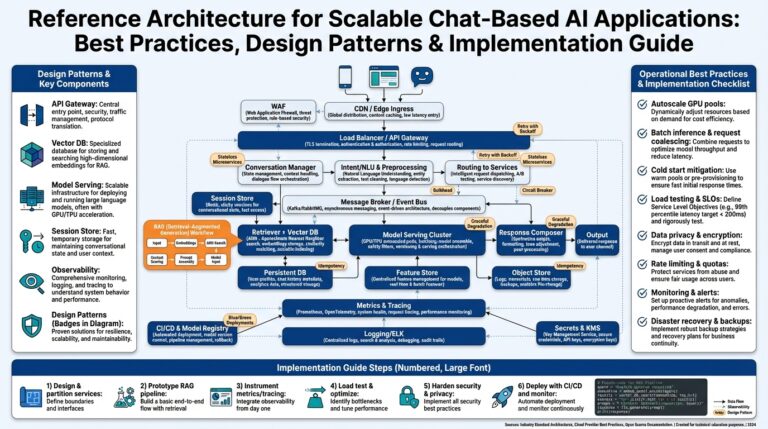
Tooling and integration patterns matter: orchestration, model ops, and vector stores are now first-class engineering concerns in data science stacks. Treat your vector database (a vector store that indexes embeddings for semantic search) like a stateful datastore with versioning and access controls. Orchestrate model pipelines with retries and canarying: ingest → embed → retrieve → generate → evaluate → persist. For inference, prefer lightweight local fine-tuning or instruction-tuning wrappers rather than frequent large-model fine-tunes; that reduces cost and latency while preserving performance for specific tasks.
Governance and testing are where projects either succeed or quietly fail. Build evaluation suites that combine automated metrics (ROUGE, factuality scores, embedding-similarity thresholds) with targeted human-in-the-loop checks for high-risk outputs. Monitor drift not only on data distributions but on semantic performance: track embedding-space shifts, retrieval recall, and prompt-sensitivity. Apply access controls and data minimization for prompts that touch sensitive data, and keep prompt and model artifacts in version control alongside tests so you can reproduce a specific generated output months later.
Taking this concept further, plan your roadmap around measurable business outcomes rather than feature novelty. Ask pragmatic questions: When should we replace a rule-based report with a generative one? What does a safe roll-back look like if a GenAI component degrades? By answering those operational questions and integrating GenAI into your CI/CD, observability, and governance layers, we turn generative AI from a research curiosity into a dependable part of the data science toolkit. In the next section we’ll map these patterns onto specific tools and templates you can adopt immediately.
Practical Use Cases and Examples
Generative AI is no longer a toy for demos — in data science pipelines it becomes a decisioning component you must instrument, test, and govern. Building on RAG and vector database patterns we discussed earlier, the most productive projects are those that operationalize generation as a repeatable service: ingest → embed → retrieve → generate → evaluate → persist. If you treat generative models as part of your CI/CD and observability stack from day one, you get measurable impact instead of brittle prototypes. How do you move from notebook experiments to reliable production behavior without increasing risk?
Start with automated reporting that replaces brittle rule engines with RAG-backed synthesis anchored to your documents and data tables. The topic sentence here is: use a vector database to surface factual passages, then constrain the generator to those passages so reports remain auditable. In practice you’ll implement a two-step call: first retrieve top-k passages by embedding similarity, then call the model with an instruction template that explicitly cites retrieved sources. A concrete pattern looks like: passages = retrieve(query, top_k=5) prompt = format_prompt(query, passages) summary = synthesize(prompt, max_tokens=800) persist_report(summary, provenance=passages) — this keeps provenance, enables regression tests, and reduces hallucinations in production reports.
Apply generative models for targeted synthetic data when labeled examples are scarce or hazardous to collect. The main idea is to generate constrained edge cases that reflect your domain schema and stress model boundaries rather than flood training with unconstrained text. For example, call generate_synthetic(domain_schema, constraints, n=10000) to bootstrap rare classes, then validate with deterministic unit tests and a human audit sample. We also version the synthetic channel separately in the feature store so you can trace label provenance and roll back if synthetic augmentation harms downstream metrics.
Use generative techniques to produce counterfactuals and localized explanations for model debugging and fairness audits. The actionable point: synthesize minimal perturbations conditioned on feature distributions and check model outputs to reveal brittle decision surfaces. We implement this by retrieving nearest training examples from the vector database, perturbing relevant features, and asking the model to explain decision deltas — e.g., retrieve_examples(x, k=10); counter = counterfactuals(x, constraints); explain = explain_diff(x, counter, context=examples). That combination — retrieval plus generation — gives explanations that are both plausible and grounded in data.
Feature engineering benefits when you treat a generative model as a suggestion engine integrated into your feature store workflows. The thesis here is: use lightweight instruction-tuning or adapter layers rather than frequent full fine-tuning so you can cheaply tailor candidate features to team conventions. Pipeline code typically looks like: propose = suggest_features(schema, sample_rows); vet = run_stat_tests(propose); push = canary_push(vet, rollout_pct=1); gate on metrics such as feature importances and validation AUC before wider release. Canarying and metric gating let us deploy generative-derived features incrementally while maintaining model stability and observability.
Governance and testing are the non-negotiable safety net for any production generative workflow. You should monitor embedding-space drift, retrieval recall, and prompt-sensitivity with concrete thresholds — for example, fail a run if mean cosine similarity to the knowledge corpus drops below 0.78 or retrieval recall for labeled queries falls under 90%. Combine these automated gates with periodic human-in-the-loop audits for high-risk outputs and keep prompt templates, retrieval indices, and model versions in the same version control system as your tests. These measures let you reproduce an output, roll back quickly, and quantify downstream business impact.
Taken together, these examples show how to translate generative models into practical, measurable components of your data science stack rather than one-off demos. We’ve shown patterns you can implement now — RAG-grounded synthesis for reporting, constrained synthetic data for rare classes, retrieval-anchored explanations for debugging, and controlled feature suggestion with canary rollouts — and each pattern ties into the orchestration, model ops, and governance controls you already run. Next, we’ll map these patterns to concrete tools and templates you can adopt immediately to move from prototype to production.
Top Tools, Models, and Platforms
When you move generative systems out of notebooks and into production, the tool choices you make determine whether GenAI becomes a repeatable decisioning component or a fragile experiment. Start by thinking in layers: a vector database for retrieval, a synthesis model for generation, and a model-ops/serving layer that ties them into your pipeline. Those three components—vector store, LLM, and model ops—are where you should focus engineering effort and budget early, because they directly affect cost, latency, and auditability.
Choosing a vector database is one of the most consequential platform decisions you’ll make because it anchors retrieval-augmented generation (RAG) performance and provenance. Managed options like Pinecone give you predictable scale and low ops overhead, while open-source engines such as Milvus, Weaviate, Qdrant, and Chroma trade operational complexity for control and cost efficiency; the right pick depends on latency targets, scale (tens of millions vs billions of vectors), and feature needs like hybrid search or built-in vectorization. How do you pick between managed and self-hosted vector stores? Benchmark with representative workloads (embedding size, filter predicates, top-k), and gate choices on predictable tail latency and index maintenance cost rather than feature checklists. (medium.com)
Treat the vector store like state: version your indices, track embedding model versions alongside vectors, and enforce access controls and backup policies just as you would for any critical datastore. Operational practices matter: run periodic re-embedding jobs when you change your embedding model, record per-vector metadata for provenance, and expose vector-store health metrics (index recovery, disk pressure, mean query cosine similarity) to your observability stack. Those controls let you reproduce a retrieval result months later and enforce the RAG pattern we described earlier without silent drift. (wealthrevelation.com)
On the model side, you’ll balance open-weight LLMs and hosted APIs by tradeoffs in cost, latency, and control. Open models from major labs (Llama family variants, Gemma, Falcon/Mistral-class families and other community releases) give you deployable weights for low-latency, on-prem inference or adapter-based tuning, while hosted large models and multimodal services often win on scale and managed safety tooling. Choose models by evaluation on task-specific benchmarks (factuality for reporting, calibration for classification augmentation) and by the effort required to instrument them for predictable behavior in production. (techradar.com)
Model ops and serving layers glue everything together; pick platforms that support LLM-specific concerns like streaming token output, multi-node model loading, and KV-prefill/caching for reduced time-to-first-token. MLflow’s newer LLM-focused features for tracing and prompt registries are useful for lifecycle tracking, while serving frameworks such as Seldon, KServe, and BentoML provide autoscaling, token streaming, and multi-GPU inference patterns you’ll need for production GenAI. Integrate these with canary/deadman gates: shadow traffic for a week, embed-space drift alerts, and automated rollback triggers tied to downstream business metrics rather than only model loss. (databricks.com)
In practice, assemble a short list and prototype an end-to-end pipeline: ingest → embed → index → retrieve → synthesize → evaluate → persist, then measure business KPIs at each step. Prefer modular stacks so you can swap an embedding model or vector store without touching serving logic; use adapters or instruction-tuning for task alignment instead of full model re-training when latency or cost is a constraint. Taking these engineering-first choices—vector database operationalization, model selection by deployment constraints, and LLM-aware model ops—lets us move from promising demos to reliable generative components. In the next section we’ll map these patterns to concrete templates and example configurations you can lift into your CI/CD and observability pipelines.
Selecting Tools: Criteria and Tradeoffs
Picking the right stack for generative AI in your data pipelines starts with clarifying what you actually need the system to guarantee: factual grounding, predictable latency, or tight cost control. In practice you should name the measurable outcomes up front — for example, a 95th-percentile inference latency under 200ms for interactive reporting, or a factuality gate that rejects outputs with retrieval recall below 90%. How do you trade those requirements against each other when tooling forces compromises? Framing requirements as concrete SLAs and evaluation gates turns tool selection from opinion into engineering.
Latency, cost, and auditability are the three most consequential selection criteria we use when evaluating platforms, and each pushes you toward different tradeoffs. If low latency is critical, favor collocating lightweight LLMs with GPU-backed inference or using on-prem model hosting rather than remote APIs; that reduces time-to-first-token but increases ops complexity and GPU cost. If auditability and provenance matter more, choose a vector database and model ops stack that let you version indices, embed models, and prompt templates together so you can reproduce a generated output months later. When budget dominates, managed APIs often win on developer velocity, but that convenience comes with less control over embedding versions and higher per-call cost.
Managed versus self-hosted choices are where you’ll feel tradeoffs most sharply. Managed vector databases and hosted LLMs remove operational burden and accelerate prototypes, while self-hosted vector stores and open-weight models offer lower long-term cost, customizability, and the ability to run offline or on sensitive data. Evaluate by benchmarking representative workloads: measure tail latency with your expected embedding dimension and top-k, test index update latency during re-embedding runs, and simulate peak query rates. We prefer to prototype end-to-end on a managed service for three sprints, then port the bottleneck components to self-hosting if cost projections or compliance needs justify the migration.
Integration patterns and compatibility matter as much as raw performance: treat your vector database, embedding model, and model ops layer as interoperable components with clear interfaces. Version embeddings alongside a vector index (embed_v2 → index_v2), persist per-vector metadata for provenance, and expose retrieval metrics (mean cosine similarity, retrieval recall) to your observability stack. For example, embed a sample corpus, run retrieve(query, top_k=5), and assert that mean similarity stays above a threshold before allowing downstream generation; that simple gate prevents silent drift from corrupting reports. These operational controls reduce the cognitive load when swapping an embedding model or updating an index.
Model behavior tradeoffs require task-focused evaluation: some LLMs are more fluent but less grounded, others are conservative and truncating; choosing between instruction-tuned adapters and full fine-tuning follows cost and latency constraints. If you need domain alignment with minimal latency, prefer adapters or instruction-tuning wrappers that let you customize behavior without retraining entire weights; if peak accuracy on a single, mission-critical task justifies it, schedule a controlled full fine-tune with canary rollout and metric gates. Always quantify tradeoffs with downstream business KPIs (report accuracy, false positives in generated features, or model A/B lift) rather than proxy metrics alone.
Tool selection is ultimately a risk-and-value calculus: pick components that map to your SLAs, instrument them for reproducibility, and plan clear migration paths for the inevitable tradeoffs between control, cost, and speed. Building on our earlier RAG and orchestration patterns, we recommend short, measurable prototypes that exercise the full pipeline so you can make decisions driven by data rather than vendor promises. In the next section we’ll convert these criteria into a short list of concrete templates and starter configurations you can lift into CI/CD and observability.
Integrating GenAI into Data Pipelines
Building on this foundation, the real engineering work is about making generative models behave like predictable, auditable services inside your existing data pipelines rather than experimental toys. You should treat GenAI components as stateful stages in an orchestration graph: they receive curated inputs, emit verifiable artifacts, and expose health and drift signals to the rest of the system. When you design this way, you can apply the same CI/CD, testing, and rollback disciplines you already use for ETL and model training. This framing shifts responsibility from ad-hoc prompts to reproducible artifacts (embeddings, retrieved passages, prompt templates, model versions) that can be versioned and tested.
Start by codifying the two-step RAG pattern as explicit pipeline steps: ingest and embed, index and retrieve, then synthesize and evaluate. The topic sentence here is: make retrieval the contract that bounds generation. Implement retrieval as an idempotent service that returns a ranked set of passages plus provenance metadata, and then call the generator with a templated instruction that cites those passages. For example, a pipeline stage can expose a simple interface like retrieve(query, top_k=5) → format_prompt(query, passages) → synthesize(prompt, model_version). That clear separation reduces hallucination risk and lets you unit test generation by mocking retrieval outputs and asserting downstream invariants.
Operationalizing embeddings and the vector database is non-negotiable because they are the grounding layer for almost every production RAG flow. Treat the vector store as a versioned datastore: record embedding model version, per-vector metadata (source_id, ingestion_timestamp, checksum), and an index version identifier for every commit. When you upgrade an embedding model, run a re-embedding job behind a feature flag and measure retrieval recall and mean cosine similarity before switching traffic. How do you detect silent degradation? Gate generation runs with retrieval metrics: fail if mean similarity drops below a task-specific threshold or if recall on a labeled validation set falls under your SLA.
Integrate GenAI stages into your orchestration and model ops stack so you get observability, retries, and safe rollbacks without manual intervention. Instrument each stage with time-to-first-token, tail latency, token-count cost, and semantic metrics (embedding drift, retrieval recall, factuality score). Use canarying patterns familiar from serving: shadow the new generator or an updated index on a percentage of traffic, compare downstream KPIs, and automate rollback if business metrics degrade. We recommend keeping prompt templates, retrieval indices, and model identifiers in the same repository and pipeline as your tests so a single commit can reproduce an entire generated artifact weeks later.
For synthetic data and feature generation, isolate the synthetic channel inside the pipeline so provenance and impact analysis remain tractable. When you call a generator to produce constrained examples or candidate features, tag those outputs with provenance labels like synthetic:true and store them in a separate feature-store partition. Validate synthetic augmentation with deterministic unit tests (schema conformance, label consistency) and low-latency audits by human reviewers before merging into training sets. This isolation prevents accidental contamination of production training data and makes it simple to roll back a synthetic experiment if downstream metrics move in the wrong direction.
Finally, plan for governance and ongoing validation as parts of your deployment workflow rather than afterthoughts. Build automated gates that combine embedding-space thresholds, retrieval recall checks, and human-in-the-loop reviews for high-risk outputs, and tie those gates to deployment decisions in your CI/CD. By integrating GenAI into orchestration, model ops, and the vector store lifecycle we create pipelines that are maintainable, auditable, and measurable—ready for incremental rollout into production. In the next part we’ll map these operational patterns to starter templates and concrete tool choices you can lift into your pipelines.
Evaluation, Governance, and Best Practices
Building on this foundation, you need evaluation and governance practices that treat Generative AI as a measurable, auditable system rather than a black box. Start by anchoring evaluation to retrieval-augmented generation (RAG) contracts and vector database behavior: if your retrieval layer changes, downstream generation must be re-evaluated. Treat metrics and provenance as first-class artifacts—embedding model version, index snapshot, prompt template, and model identifier should all travel together through CI. This focus makes it possible to reproduce an output, attribute responsibility, and reason about risk when a generated artifact affects decisions.
How do you know when a generator’s output is trustworthy? Build a multi-tiered evaluation suite that combines automated signals with targeted human review. At the automated level, validate retrieval recall on a labeled validation set, monitor mean cosine similarity in embedding space, and compute task-specific factuality or calibration scores; fail the pipeline if any gate crosses a task-defined threshold. Complement those gates with small, sampled human audits for high-risk categories—policy, compliance, or safety-sensitive reports—so we don’t rely on proxy metrics alone. Make downstream business KPIs (conversion lift, error reduction, time saved) the ultimate arbitrator: instrument A/B tests and measure real impact rather than optimizing on proxy metrics indefinitely.
Governance must be proactive and risk-based rather than a checklist you bolt on at the end. Enforce least-privilege access to prompt templates, vector indices, and model endpoints and minimize sensitive data in prompts using programmatic redaction or tokenization. Record every prompt and returned passage to an immutable log so you can trace an output back through retrieval and synthesis; store that log alongside your versioned index metadata. Use role-based reviews and scheduled audits for the highest-risk workflows, and require human sign-off before any generated content that affects customers or regulatory reporting is promoted out of canary.
Integrate evaluation and governance into your CI/CD so checks run automatically with every change. Implement blocking gates that assert retrieval metrics (for example, assert mean_cosine_similarity >= 0.78) and downstream validation tests before a model or index switch goes live. Use shadowing and canary deployments: run the new generator on a portion of traffic, compare downstream KPIs to the incumbent, and automate rollback when business metrics degrade. These patterns let us iterate quickly while preserving safety—small, measurable experiments instead of risky big-bang swaps.
When you generate synthetic data or features, isolate provenance and impact analysis by design. Tag generated examples with synthetic:true, store them in a separate partition of the feature store, and run deterministic schema and label-consistency tests before any merge. Add a human-in-the-loop sample audit for novel synthetic classes and gate full adoption on measured model improvement in a holdout evaluation. This separation prevents contamination of production training sets and gives you a straight rollback path if augmentation hurts performance.
Observability for Generative AI needs semantic signals in addition to latency and cost. Track time-to-first-token, 95th-percentile latency, token-cost per query, embedding-model drift (cosine shifts against a baseline), retrieval recall on labeled queries, and prompt-sensitivity variance across paraphrases. Surface these metrics in dashboards and back them with automated alerts that tie to SLOs (for example, retrieval-recall SLO and token-cost SLO). Instrumenting these signals lets you detect silent degradations early and schedule re-embedding or model updates under an explicit, measured cadence.
Finally, adopt a governance decision framework that maps risk to process: low-risk flows get automated gates and lightweight audits, medium-risk flows require periodic human review and canary rollouts, and high-risk flows need exhaustive provenance, legal sign-off, and stricter SLAs. Plan regular re-embedding cycles, maintain a prompt registry for reuse and audit, and document rollback playbooks alongside metric thresholds so your team can act quickly when a drift or failure appears. Taking these operational steps turns generative systems from intermittent demos into reliable components you can trust in production and prepares us to map these controls to specific tools and templates next.