What SQL Expression Indexes Do
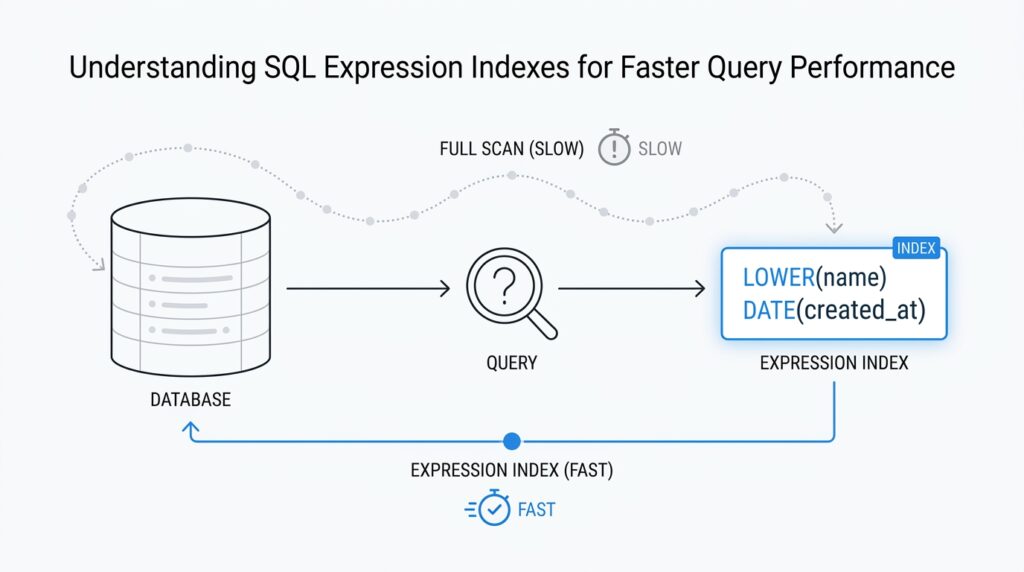
When a query keeps asking for the same computed result, SQL expression indexes give the database a ready-made shortcut. Instead of recalculating something like lower(email) or first_name || ' ' || last_name for every row at search time, the database stores that expression’s result inside the index and can look it up much faster. In PostgreSQL, for example, indexes can be built on expressions, and SQLite also supports indexes on expressions for matching WHERE and ORDER BY clauses.
You can think of an expression index as a bookmark for a calculation. If your table is a big library, a normal index points to a column value, while an expression index points to the answer to a question you ask over and over. That makes it especially useful for case-insensitive lookups, name combinations, cleaned-up phone numbers, or any other value that your query builds on the fly. When we talk about SQL expression indexes, we are really talking about turning repeated work into stored work.
What matters most is that the query has to line up with the expression you indexed. PostgreSQL explains that the planner can use an index on something like lower(col1) for a query that searches on lower(col1), and SQLite says the expression must match the indexed expression very closely for the planner to consider it. In plain language, the database is not guessing its way to the shortcut; it is matching the same computation you told it to remember.
That also explains why expression indexes feel so fast when they help and so invisible when they do not. During the search itself, the database is reading the stored index entries rather than recomputing the expression for every row, so the lookup behaves much like a normal index scan. But the tradeoff is real: each insert and non-HOT update has to compute and maintain the indexed expression, which adds overhead on writes.
SQL expression indexes can also enforce rules, not just speed up lookups. PostgreSQL notes that a unique expression index can prevent rows whose computed values collide, such as values that differ only by letter case when the index is built on lower(col1). That gives you a practical way to protect business rules that do not fit neatly into a simple column-by-column uniqueness check.
So what do SQL expression indexes do in everyday use? They let you pay the cost of a calculation once, then reuse that result whenever the same question comes back. That is why they can feel like a small trick with a big payoff: they are not a magic speed boost for every query, but they are a very sharp tool when your search pattern keeps returning to the same expression.
When Expression Indexes Help
Sometimes the moment is simple: you have a query that feels like it should be fast, because you are filtering on a familiar field, but the database still has to work too hard. That is where expression indexes shine. They help most when your query keeps asking for the same computed answer, and when reading that answer matters more than paying for the computation on every search. PostgreSQL describes this as storing a function or scalar expression so the database can reach rows based on the result of a calculation, while also warning that indexes add write overhead and should be used sensibly.
A good clue is that your query keeps reshaping data before it searches. Maybe you are doing a case-insensitive lookup with lower(email), or joining first and last names into a full-name search, and the database keeps repeating that work row after row. PostgreSQL gives both of those patterns as examples of where an expression index can help, because the index can store the transformed value ahead of time instead of rebuilding it every time the query runs. In everyday terms, it is like writing the answer on a sticky note before the question arrives.
This is also why expression indexes are so helpful for searches that feel “obvious” to a person but not to the database. If you index x + y, SQLite will only consider that index when the query uses the same expression in the same shape, such as x + y, not a mathematically equivalent version like y + x. The SQLite query planner does not do algebra; it looks for a close match between the indexed expression and the query expression. So when you ask, “Why is my expression index not being used?”, the first thing to check is whether the query really matches the indexed expression.
Expression indexes also help when you sort or filter by a derived value instead of a raw column. SQLite shows this with an index on abs(amt), which speeds up searches like “show me the biggest changes” or ordered lists based on absolute amount. PostgreSQL makes the same point in its own example with lower(col1) = 'value': once the database has the computed value stored in the index, the search behaves much like a normal index lookup. In other words, the index becomes valuable when the derived form of the data is the form you reach for again and again.
They are especially useful when the expression is stable and predictable. SQLite requires functions used in expression indexes to be deterministic, meaning the function always returns the same output for the same input; non-deterministic functions like random() do not belong there. PostgreSQL also notes that expression indexes are relatively expensive to maintain because the derived value must be computed during inserts and updates, so they make the most sense when retrieval speed matters more than write speed. That tradeoff is the heart of the decision: if your table changes constantly but the query is rare, the payoff may be small.
They can even help beyond speed when the computed value carries a business rule. PostgreSQL says a unique expression index can prevent rows whose transformed values collide, such as values that differ only by case when you index lower(col1). That means expression indexes are useful when your rule lives in the transformed version of the data, not the raw column itself. So the strongest signal is this: if the same computed expression shows up often, matches exactly, and supports a query or rule you care about, an expression index is probably doing real work for you.
Create Your First Expression Index
When you create your first expression index, you are giving the database a memory for a calculation it keeps repeating. Instead of asking the engine to rebuild the same result row by row, you store that result in the index and let future searches reuse it. PostgreSQL supports indexes built on functions or scalar expressions, and SQLite supports the same idea as long as you follow its expression-index rules.
A familiar first example is a case-insensitive email search. If your application keeps asking for lower(email), the database can make that exact transformed value available ahead of time. In PostgreSQL, the pattern looks like this:
CREATE INDEX users_email_lower_idx ON users (lower(email));
SQLite uses the same basic CREATE INDEX shape, because expression indexes are created by listing an expression where a column would normally go. The idea is the same in both systems: you are indexing the answer to the question, not the raw column alone.
The next step is where many beginners pause, because the query has to match the index expression closely. SQLite is especially strict here: x + y matches x + y, but not the mathematically equivalent y + x, because the planner does not do algebra for you. PostgreSQL gives the same practical lesson with lower(col1): the query benefits when it uses the same expression you indexed. If you are wondering, “Why is my expression index not being used?” this exact-match rule is one of the first things to check.
It also helps to think about the function inside the expression. SQLite only allows deterministic functions in an expression index, which means the function must return the same output for the same input every time. That excludes values like random() and other changing functions, because the stored index entry would stop being trustworthy. PostgreSQL treats expression indexes as stored search structures too, so the tradeoff is familiar: faster lookups on the read side, more work when rows are inserted or updated.
A good first test is to choose one query that keeps coming back, then shape the index around that one expression and nothing extra. If you are searching by cleaned-up phone numbers, folded text, or absolute values, the goal is to make the indexed expression mirror the real search pattern as closely as possible. SQLite’s documentation even gives examples like abs(amt) for magnitude-based searches, which makes the benefit feel concrete: you are indexing the form of the data you actually ask about.
There is one more payoff that makes expression indexes feel especially practical: they can protect rules as well as speed up reads. PostgreSQL notes that a unique expression index can prevent duplicates based on a transformed value, such as values that differ only by letter case when the index is built on lower(col1). So when you build your first expression index, you are doing two things at once: teaching the database a shortcut, and, if needed, teaching it a rule about what counts as the same value.
Verify Performance With Query Plans
Once you have an expression index in place, the safest way to see whether it is really earning its keep is to ask the database to show its query plans. In PostgreSQL, EXPLAIN reveals the plan the planner chooses, and EXPLAIN ANALYZE goes one step further by actually running the statement and adding real timing and row-count statistics. In SQLite, EXPLAIN QUERY PLAN gives a high-level view of how the statement would run, which is meant for troubleshooting rather than for application logic. That makes query plans less like a guess and more like a map: we can see whether the database is taking the shortcut we built for it, or walking the long road anyway.
When you read that map, the first thing to look for is whether the plan mentions your index at all. In PostgreSQL, a healthy plan often shows an Index Scan, while SQLite’s output usually says SEARCH and names the index it used; by contrast, Seq Scan in PostgreSQL or SCAN in SQLite means the engine is reading the table row by row. That does not always mean failure, because tiny tables can still be cheaper to scan directly, but on a larger table it usually tells us the expression index did not become part of the route. If the plan also shows a temporary sort structure for ORDER BY, that is another clue that the shortcut was not enough to carry the whole query.
The next question is the one readers usually ask: why is my expression index not being used? The most common answer is that the query does not match the indexed expression closely enough. SQLite is very strict here; if you index x+y, a query written as y+x will not use that index even though the math is the same, because the planner looks for the same expression, not an algebraically equivalent one. PostgreSQL gives the same practical lesson with examples like lower(col1), where the query can use an index built on lower(col1) and the system treats the search like a normal indexed lookup. In other words, query plans are not only measuring performance; they are also checking whether the expression index and the query are speaking the same language.
That is why a good test is to compare plans before and after you create the index, using the exact query your application runs in real life. In PostgreSQL, EXPLAIN ANALYZE is especially helpful here because it shows actual runtime statistics, but it also executes the statement, so it can affect data unless you wrap write tests in a transaction and roll back afterward. PostgreSQL also notes that planner estimates depend on up-to-date statistics, so if the table has changed a lot, you may need to refresh statistics with ANALYZE before trusting the plan. A plan is useful only when we read it in context; otherwise we might blame the index for a choice that was really driven by stale stats or a query shape that changed in the last mile.
So the habit to build is small but powerful: run the query, inspect the plan, and look for the moment the database stops doing extra work. If the expression index is working, you should see the scan change from broad table reading to targeted index use, and that usually pairs with lower execution time in PostgreSQL or a SEARCH record in SQLite. If it does not happen, the plan is giving you a clue, not a failure, and the clue usually points back to expression shape, query form, or statistics. That leaves us with the real payoff of query plans: they let you verify the shortcut now, before you rely on it everywhere later.
Common Pitfalls And Limitations
When SQL expression indexes start looking like the answer to every slow query, the first surprise is that they are a little more delicate than they seem. They work best when the query and the indexed expression stay in lockstep, and that can be easy to miss when a real application grows messy. So the first limitation is also the most common pitfall: an expression index only helps when the database can recognize the exact shape of the expression you asked it to remember.
That is why a query can look perfectly sensible to you and still miss the shortcut entirely. If you build an index on lower(email), but your code searches with a slightly different expression, the planner may walk right past it. When people ask, “Why is my expression index not being used?”, this is often the reason: the database is not trying to be clever, it is trying to match patterns. SQL expression indexes reward consistency, and they punish drift.
Another trap appears when we assume every expression is fair game. Some databases require the indexed function to be deterministic, meaning it must return the same result for the same input every time. A function that depends on the clock, randomness, or outside state can make the stored value unreliable, so it does not belong in an expression index. That restriction can feel picky at first, but it protects the index from turning into a stale note that no longer matches reality.
Write-heavy tables create a different kind of friction. Expression indexes speed up reads, but they also add work every time a row is inserted or updated because the database has to recompute and maintain the indexed result. If your data changes constantly and the search only happens once in a while, the cost may outweigh the benefit. In practice, that means SQL expression indexes are not a blanket performance trick; they are a tradeoff, and query performance improves only when the read path matters enough to pay for the extra write effort.
We also need to be careful not to expect an expression index to rescue a poorly shaped query. If the query asks for a broad slice of the table, or if it mixes the indexed expression with other filters that still force a scan, the gain may be small. The index can only shorten one part of the journey; it cannot rewrite the whole trip for you. That is why expression indexes shine for repeated, focused lookups, but feel underwhelming when the query itself is too open-ended.
Portability can also become a quiet limitation. Different databases support SQL expression indexes in different ways, and even when they all support them, the matching rules may not be the same. A query that benefits in one engine may behave differently in another, especially if the planner demands a very close expression match. If your application has to move across systems, that means the index design should be tested with the target database, not assumed from habit.
Then there is the human side of the problem: expression indexes are easy to forget about after they are created. A teammate may later change the query, wrap the expression in another function, or reorder terms in a way that looks harmless but breaks the match. That is how SQL expression indexes quietly stop pulling their weight. The safest habit is to keep the indexed expression and the application query aligned, and to revisit the index whenever the query pattern changes.
So the real limitation is not that expression indexes are weak; it is that they are specific. They work like a carefully labeled shortcut on a familiar path, not like a map that adapts to every detour. When we treat them that way, they stay useful, predictable, and worth the maintenance they ask for.
Best Practices For Ongoing Maintenance
Once an expression index is in place, the real work shifts from building the shortcut to keeping it honest. SQL expression indexes age in the same way a well-used shortcut does: if the road changes, the sign has to change too. That means ongoing maintenance is less about babysitting the index and more about making sure the index still matches the query patterns your application actually uses.
The first habit is to revisit the query itself whenever application code changes. A small rewrite can be enough to break the match between the query and the stored expression, and then the database quietly stops using the index you worked so hard to create. If you are asking, “Why did my SQL expression index stop helping after a deploy?”, the answer is often that the query shape drifted just enough to miss the planner’s pattern. Keeping the indexed expression and the live SQL in sync is one of the most important parts of expression index maintenance.
The next habit is to watch for changing data behavior. An expression index that was perfect for a rare search pattern can become expensive if the table turns into a write-heavy workload. Every insert, update, or cleanup that touches the indexed column has to keep the derived value current, so we want to keep asking whether the read benefit still outweighs the write cost. SQL expression indexes are most valuable when the same transformed lookup keeps coming back, not when the underlying data changes so often that the shortcut turns into a burden.
It also helps to treat query plans as a regular checkup instead of a one-time test. After a schema change, a code refactor, or a jump in row counts, run the same plan you used when the index was first created and see whether the planner still chooses it. If the plan shifts from targeted index use to a broader scan, that is a signal to investigate before performance drifts too far. This is especially important because the database can only make a good choice when its statistics are current and the query still speaks the same language as the index.
That brings us to a practical maintenance rhythm: keep statistics fresh and keep the index purposeful. In PostgreSQL, updated statistics help the planner estimate whether an expression index is worth using, and in any engine, a stale picture of the table can lead to a bad route. At the same time, resist the urge to leave old indexes lying around “just in case.” If nobody uses the expression any more, the index is not a helper; it is maintenance overhead that slows writes and adds clutter.
A good maintenance pass also looks at the expression itself, not just the query around it. As your application grows, you may discover that the original expression was too narrow, too broad, or tied too closely to one code path. Maybe the search now needs normalization before comparison, or maybe a different derived value has become the real hot path. In those moments, it is better to rebuild the index around the current business rule than to keep forcing new code to fit an old shortcut.
Finally, document why the index exists. That may sound unglamorous, but it pays off the next time someone wonders why the database has a lower(email) index or an index on some other derived value. A short note explaining the query pattern, the performance goal, and the cases where the index should be rechecked gives future maintainers a map instead of a mystery. SQL expression indexes are strongest when they are treated as living parts of the system, not one-time tricks frozen in place.
If we keep that mindset, maintenance becomes much easier to reason about: confirm the query still matches, confirm the planner still uses the shortcut, confirm the write cost is still worth it, and retire the index when it no longer earns its keep. That steady check-in keeps expression indexes sharp, useful, and aligned with the real shape of the workload.