Recognize Common AI Misuse Patterns
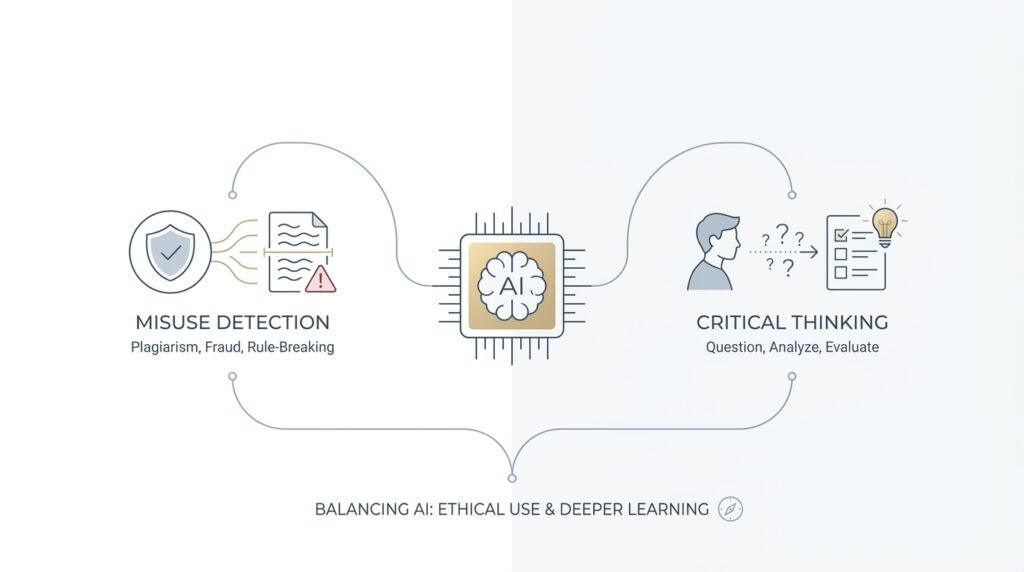
When you start looking for AI misuse in student work, the first thing to notice is the feeling of a submission that sounds polished but strangely airless. It may read smoothly, yet it avoids the small, specific details that usually reveal a real learner at work. That is why recognizing common AI misuse patterns matters in academic integrity: generative AI can produce fluent text, but fluency alone does not prove understanding, and institutions are advised to combine any detection with human judgment rather than treat a score as the whole story.
One of the clearest patterns is a sudden shift in voice. You may see a student who wrote with a direct, informal tone in class discussion, then submitted a final draft that sounds stiff, generic, and oddly balanced in every paragraph. In generative AI in education, that change often shows up as language that feels neat on the surface but less personal underneath, with repeated transitions, broad claims, and very few concrete examples from class. That does not prove misuse on its own, but it is a useful signal that the writing process may have changed partway through the assignment.
Another pattern appears when the answer is complete enough to look finished, but not connected enough to fit the prompt. The student may cover the general topic while missing the course material, the local context, or the specific argument the question asked for. This matters because language models can produce confident-sounding statements that are not true, a problem often called hallucination, which means the system generates something that sounds right even when it is wrong. So when you ask, “Does this response really answer the assignment, or does it only orbit around it?”, you are looking for whether the work shows real thought rather than a well-shaped summary.
Source use gives us another cluster of clues. AI misuse can show up as references that do not match the claims in the paragraph, citations that look formatted correctly but do not exist, or paraphrases that stay too close to a source while changing only a few words. Turnitin also notes that AI writing reports and similarity reports are different things, which is an important reminder that matching text is not the same as identifying AI-generated text, and that AI-paraphrased or “bypassed” writing may need closer review. In other words, the paper may look tidy from a distance, yet the trail of evidence underneath feels thin or inconsistent.
The most revealing pattern is often the missing process behind the product. When a student used AI as a crutch, they may struggle to explain how the idea developed, why a source was chosen, or how a conclusion was reached. That is why a short conversation can be more informative than a quick judgment: if you asked, “How did you get from your first idea to this draft?”, could the student walk you through the steps in their own words? Turnitin’s guidance emphasizes human review and conversation because the goal is not to punish first, but to understand whether the work reflects the student’s own thinking.
As we move through the rest of this topic, the real skill is not hunting for a single smoking gun. It is learning to notice patterns that suggest a mismatch between the writing and the learner, then responding with questions that invite explanation, reflection, and revision. That shift keeps AI misuse from becoming the whole story and opens the door to better critical thinking instead.
Set Clear Academic Use Rules
When AI in education enters the classroom, the first thing students need is not suspicion but a map. Generative AI, meaning software that can produce new text, images, or code from patterns it learned, works best when the expectations around it are visible from the start. UNESCO argues for coherent, comprehensive policy frameworks, and transparency guidance says AI expectations should appear in the syllabus or learning platform, not remain as hidden classroom lore. Without that map, students are left guessing, and guessing is a weak foundation for academic integrity.
What do academic use rules for AI in education actually look like in practice? They name the tool, the task, and the level of help. Transparency guidance recommends that internal records identify the tool used, the model and version if available, and the nature of the contribution, while the student-facing version should disclose AI-generated portions in the syllabus or LMS, which is the learning management system, a digital hub for course materials and assignments. That kind of rule feels less like a ban sign and more like a road sign: it tells you which lane you are in before you start moving.
Students also need a plain answer to the question they are often too nervous to ask: what counts as acceptable AI help? Turnitin’s student guidance says its AI Assistant is meant to support original work, brainstorming, and critical thinking, not write the entire assignment, and it tells students to check their course and institution policies, cite AI use when required, and keep the majority of the work as their own thinking. That means a student should know ahead of time whether AI can help with outlining, revising, or research notes, and whether that help must be disclosed in the final submission.
The clearest academic use rules are also the ones that protect the process, not only the product. UNESCO notes that many institutions have been slow to publish formal guidance, which leaves students and teachers navigating uncertainty, and Turnitin reminds educators that its AI writing report is not definitive on its own and must be read alongside human judgment and institutional policy. So when we ask students to keep drafts, explain choices, or talk through revisions, we are not adding extra hoops; we are making their thinking visible enough to assess fairly.
This is where clear rules do double duty. They reduce the blur around AI misuse, but they also make room for honest learning, because a student who knows the boundaries can use generative AI as support without outsourcing the work of thinking. When the rules say what must be disclosed, what must be cited, and what must remain personal effort, they turn a tense guessing game into a shared academic language. That shared language is what lets us ask for better work instead of merely policing the worst cases.
The most useful rules feel calm, specific, and repeatable. They tell students what is allowed, what needs permission, and what needs a conversation with the instructor before the draft ever begins. Once those boundaries are visible, we can move from catching hidden shortcuts to teaching students how to use AI responsibly, disclose it honestly, and still practice the critical thinking that school is meant to strengthen.
Design Assessments That Resist Automation
Once we have clearer rules, the next question feels more practical: how do we design assessments that resist automation in the first place? In other words, how do we build assignments in AI in education that ask for thought, not only polished output? The answer is to make the work behave like a conversation with the learner, because generative AI can draft a surface very quickly, but it struggles to reveal a student’s reasoning, choices, and changing understanding over time.
That means we shift away from one-and-done assignments that reward a finished paragraph more than a finished mind. A highly automatable task usually has a narrow prompt, a predictable structure, and a single correct-looking answer. By contrast, an assessment built to support critical thinking leaves room for interpretation, judgment, and revision, which makes the student’s thinking visible. When we ask for a response that depends on course-specific materials, personal analysis, or local context, we create more than a deliverable; we create evidence of learning.
One of the strongest design moves is to ask students to work with something AI cannot easily know: their own process. Instead of only submitting the final essay, we can ask for a short proposal, a rough outline, a draft note, and a reflection on what changed between versions. That sequence matters because it shows how ideas evolve, and evolution is harder to automate than appearance. If you are wondering, “How do you design assessments that resist automation without making them harder for the sake of it?”, this is the heart of the answer: we make the path part of the grade, not just the destination.
Another useful strategy is to ground the task in a specific situation that requires judgment. A generic prompt like “Explain the causes of climate change” invites broad, recycled language, while a prompt that asks students to evaluate a local policy, compare two cases from class, or apply a concept to a recent event asks them to make decisions. That difference may seem small, but it changes everything. Generative AI can summarize widely available information, yet it is much less reliable when the assignment demands context, tradeoffs, and a reasoned stance.
We can also make room for assessments that sound more like real thinking and less like final performances. A brief oral check-in, a conference with the instructor, or a short recorded explanation gives students a chance to talk through their choices in plain language. This does not have to feel like an interrogation; it can feel like a pit stop where the learner explains the route they took. Those moments help us see whether the written work matches the student’s understanding, and they remind students that academic work is not only something to submit but something to explain.
Another way to resist automation is to ask students to compare, revise, and defend. When they must contrast two approaches, explain why one source matters more than another, or justify a change made during revision, they move from reporting information to exercising judgment. That is where critical thinking becomes visible. An automated tool can produce an answer, but it cannot sincerely own a decision the way a learner can, especially when the assignment asks them to name the reason behind their choice.
We should also remember that not every assessment needs to be large to be meaningful. Small, frequent tasks such as quick reflections, in-class writing, or low-stakes response notes can reveal more authentic learning than one high-pressure final paper. These smaller checkpoints give us a clearer picture of how students think when they are still building the idea, not only when they are cleaning up the final version. In practice, that makes AI misuse harder to hide and honest learning easier to recognize.
When we design assessments this way, we are not only protecting academic integrity; we are teaching students what real learning looks like. They begin to see that the most valuable work is often the work of choosing, revising, explaining, and defending an idea. That shift turns AI in education from a shortcut problem into a teaching opportunity, because the assignment itself starts asking for the kind of thinking that no machine can finish for them.
Apply Detection Tools Carefully
Now that we have a sense of what mismatch can look like, the next step is to handle AI detection tools with a little humility. The question is not, “Did the software catch it?” but rather, “How do we use AI detection tools without turning them into a verdict machine?” That question matters because Turnitin says its AI writing report can misidentify human-written, AI-generated, and AI-paraphrased text, and it should not be the sole basis for adverse action. In practice, that means the tool can raise a flag, but the teacher still has to read the room, the draft, and the student.
A careful review starts with context, not with panic. If a score or indicator appears, we treat it like a weather forecast: useful for planning, but not the sky itself. Turnitin’s guidance says the AI writing report is a data point, not a definitive answer in isolation, and it recommends combining the score with educator judgment, knowledge of the student, and institutional policy. That is especially important for short or borderline cases, where Turnitin notes that results below 20% are less reliable and false positives are more likely. When you see a number, the real work begins with asking what else the submission tells us.
This is also where fairness comes into the picture. UNESCO’s education guidance frames AI use through inclusion and equity, which is a helpful reminder that detection tools can affect students differently depending on their language background, writing style, or access to support. So when we apply detection tools carefully, we are not being soft on integrity; we are making sure the process is fair enough to trust. A tool that labels a student before we understand the full situation can damage confidence quickly, while a tool that invites review can support a more careful conversation.
A good next move is to pair the report with visible evidence of learning. We can look at drafts, revision history, class notes, source lists, or a quick explanation from the student about how the work came together. Turnitin’s own review guidance points educators back toward dialogue, saying that no tool can replace judgment combined with other data points when deciding whether a conversation is needed. That is why a calm question like, “Walk me through how you built this answer,” often tells us more than the score alone. It gives the student a chance to show process, and process is where genuine thinking lives.
We also need to keep our expectations realistic about what the software can and cannot do. Detection tools may highlight likely AI-generated text, but they do not read intent, and they do not know whether a student used AI for brainstorming, editing, or translation unless the course rules require that to be disclosed. Turnitin’s guidance even notes that some submissions cannot be processed because of file requirements or earlier submission dates, which means the absence of a result is not the same as proof of anything. In other words, the tool can help us notice patterns, but it cannot replace the story behind the work.
When we apply detection tools carefully, we protect both academic integrity and student learning. We avoid the trap of chasing a percentage as if it were the truth, and we make room for a fuller conversation about effort, revision, and understanding. That approach is especially valuable in AI in education, because it keeps the focus on teaching students how to think, explain, and improve their work, rather than only on catching them when something feels off. The report becomes a starting point for inquiry, not the final word.
Teach Verification and Source Checking
When a student hands in a polished paragraph, the next question is often the most useful one: where did this come from? Teaching verification and source checking gives students a way to answer that question with confidence instead of guessing, and it turns AI in education into a lesson about judgment rather than a hunt for mistakes. If you have ever wondered, “How do I know whether this information is real?”, you are already standing at the door of critical thinking, because verification begins with the habit of pausing before we believe.
The first move is to slow the reading down and treat every claim like a small mystery. A source is the place an idea comes from, while verification means testing whether that idea holds up under closer inspection. That might sound formal, but in practice it looks a lot like checking a receipt before you leave the store: we compare the claim against the evidence, look for missing details, and ask whether the source actually supports the sentence attached to it. In AI in education, this matters because a model can produce a convincing answer that sounds sourced even when it is not.
That is why source checking should become a visible classroom skill, not a hidden expectation. Students need to learn how to inspect the author, the date, the publication, and the purpose of a source, because those clues tell us whether the information belongs in the conversation. A blog post written to persuade readers, for example, does not carry the same weight as a peer-reviewed article, which is a research study reviewed by experts before publication. Once students start noticing those differences, they begin to see that research is not about collecting links; it is about choosing evidence that fits the job.
Here, verification and source checking work best when they feel like a routine rather than a rescue mission. We can model lateral reading, which means opening new tabs and checking what other trustworthy sources say about the same claim instead of staying trapped on one page. We can also ask students to trace a quotation back to its original place, because AI-generated text sometimes invents citations, misstates facts, or blends real and unreal details in a way that only careful checking can reveal. When students practice this in class, they learn that good research is less like memorizing facts and more like following a trail.
The next step is to make the process active. Instead of asking only for a final answer, we can ask students to explain why they trusted one source over another, or to note which claim they verified first and why. That kind of reflection does two things at once: it reveals whether the student understands the material, and it encourages habits that protect academic integrity. A student who can say, in plain language, how they tested a claim is showing more than compliance; they are showing discernment, which is the heart of critical thinking.
This is also where AI misuse becomes easier to spot without turning every assignment into a suspicion test. If a paper cites a source that does not match the argument, or repeats a statistic without checking whether it still applies, the issue may be weak source checking rather than deliberate cheating. That distinction matters because the response should teach the skill, not only punish the error. In many cases, students need to learn how to verify information from AI outputs the same way they would verify anything else: by comparing it with reliable sources, reading beyond the first result, and asking whether the evidence truly supports the claim.
Over time, verification and source checking become more than defensive habits. They help students build a kind of intellectual compass, one that points toward accuracy, honesty, and stronger reasoning. In AI in education, that compass is especially valuable because the most persuasive answer is not always the most truthful one. When we teach students to question, compare, and confirm, we give them a skill they can carry into every class, every research task, and every moment when the internet sounds confident but reality asks for proof.
Build Reflective AI Usage Activities
When we move from spotting AI misuse to building reflective AI usage activities, the classroom changes from a place of suspicion into a place of explanation. That shift matters because reflective tasks help students show metacognition, meaning thinking about their own thinking, while also making any use of generative AI visible enough to discuss honestly. UNESCO frames generative AI as something education should approach in a human-centered way, and university teaching centers recommend reflection, process work, and short explanatory prompts because they reveal how students got to the final answer, not just what the answer looks like.
A helpful way to begin is to ask students to narrate their work at three moments: before, during, and after the assignment. Before they start, they can write what they think the task is asking; during the draft, they can note what tools they used and why; after submission, they can explain what changed and what they would improve next time. Cornell’s guidance suggests short reflective writing can help students revisit prior thinking, and Brown’s teaching resources show that brief metacognitive prompts and self-assessment help students track what they learned and how they learned it. If you have ever wondered, “How do we ask students to use AI without outsourcing the thinking?”, this kind of staged reflection is one of the clearest answers.
Learning logs and process notes make that reflection even more concrete. A learning log is a running record of what a student did, what they noticed, what they still question, and what they plan to do next, which helps them see changes in their thinking over time. Brown notes that learning logs can serve as self-assessment and give instructors useful feedback, while MSU Denver recommends process documentation such as drafts, version histories, screenshots, or short method sections that describe tools used, including AI. In AI in education, that kind of record does two jobs at once: it supports critical thinking and gives us evidence that the work developed through actual decisions rather than a single polished paste-in.
We can also build in tiny oral check-ins, because spoken explanation often reveals understanding that the page only hints at. MSU Denver recommends short oral defenses, live or recorded, where students summarize their argument or solution and answer one or two targeted questions, and it notes that the grading should focus on conceptual understanding rather than polish. The University of Waterloo adds that breaking the assignment into pieces and discussing the process helps students build reflective thinking over time, especially when the task includes different perspectives and room for dialogue. These moments do not need to feel formal or intimidating; they can feel like a quick walkthrough where the student tells us how the path was chosen.
The next layer is to make the reflection itself easy to judge fairly. The University of Waterloo recommends clear marking criteria, exemplars, and opportunities for self- or peer-feedback, because students reflect better when they can see what strong reflection looks like. Cornell’s metacognitive prompts offer a practical pattern here: ask what worked, what did not work, what is still unclear, and what the student would do differently next time. When students know the shape of the activity, they can spend their energy on honest thinking instead of guessing what the instructor wants to hear.
Just as important, we should make AI disclosure part of the reflection itself. MSU Denver recommends a brief disclosure statement that says what tools were used and how, and its guidance notes that reflective components surface metacognition while making wholesale AI authorship harder to hide. That is exactly what we want in AI in education: not a trap, but a habit of transparency that supports academic integrity and strengthens critical thinking at the same time. Once students are asked to name their process, justify their choices, and explain their revisions, we are no longer only checking for misuse; we are teaching them how to own their learning in the open.