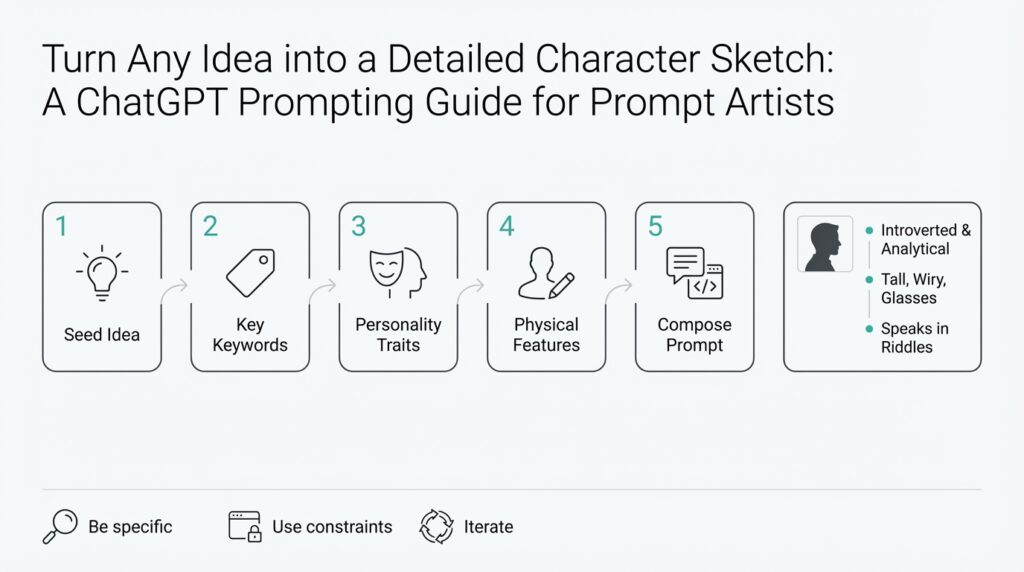
Identify core concept
Building on this foundation, the first task is to zero in on the central idea that will drive every decision in your character sketch. In prompt engineering for character development, front-loading a clear character premise helps ChatGPT produce focused, consistent output; we want that premise stated in one crisp sentence before anything else. This single-sentence premise becomes the north star for personality choices, backstory, and behavioral patterns, reducing drift across successive prompts. When you treat the premise as a rule rather than a suggestion, you get sketches that are coherent and actionable.
Start by defining the character’s highest-level motivation and the constraint that shapes them. A central idea combines motivation (what they want), obstacle (what prevents it), and context (where and when this plays out): for example, “A retired hacker fighting corporate surveillance in a near-future city.” That trio—motivation, obstacle, context—gives you a compact, testable hypothesis about the character. Use that hypothesis to create seed prompts that ask the model to generate behaviors, flaws, and micro-actions that align with the premise.
How do you distill a sprawling concept into a single, operational premise? Ask three targeted questions: What drives this character at their core? What recurring obstacle defines their arc? What environment amplifies the stakes? Use the answers to craft a one-line premise and then validate it by asking for a short justification from the model: Summarize this character’s core in one sentence and explain why it would create dramatic conflict. That validation step catches ambiguity early and saves iteration time during ChatGPT prompting.
To make this concrete, consider an idea like “an AI ethics lawyer in a hyperconnected city.” Distill it into the premise: “An ethics lawyer who prosecutes AI companies while secretly relying on unapproved neural tools.” From that one line we can infer behavioral rules: they’ll prioritize legal loopholes, conceal tool use, act defensively around colleagues, and justify ethically gray choices. Feed those rules back into prompts—List five daily habits that reveal this lawyer’s tension between law and reliance on illicit AI.—and you’ll get richly textured traits tied directly to the central idea.
Decide when to narrow and when to broaden the premise depending on your use case. If you need consistent NPCs for a game, tightly constrain motivation and routine; if you want exploratory fiction prompts, broaden context and allow the model to propose conflicting objectives. For iterative workflows, generate three premise variations, run a short sketch for each, then score them against rubrics like “conflict potential” and “unique voice.” This process—ideate, synthesize, validate—turns prompt engineering into an efficient feedback loop that produces higher-quality character sketches with predictable variety.
Taking this approach further, treat the central idea as a living artifact you revise as the sketch grows. Start with the one-line premise, use it to generate attributes and scenes, then refine the premise when gaps appear: maybe the obstacle needs sharpening or the context should shift one decade earlier. By anchoring every prompt to that evolving premise, you maintain both creative freedom and narrative coherence. Next, we’ll translate this refined premise into explicit attribute templates to drive consistent ChatGPT prompting for voice, appearance, and decision-making patterns.
Define role and objectives
Building on this foundation, the most important early step is to tell the model precisely who it should be and what it must produce—this is where character sketch, ChatGPT prompting, and prompt engineering intersect in practical terms. Start your prompt with a crisp role statement that sets expertise, voice, and perspective so the model doesn’t drift during generation. What role should the model play, and what concrete outputs do you expect? Framing the model as a specialist (for example, “You are a narrative systems designer with experience in interactive games”) immediately focuses generation toward usable, domain-appropriate detail.
Specify the role with implementation-level clarity so the model can simulate constraints and trade-offs you care about. Say whether the model is a novelist, forensic psychologist, game writer, or prompt artist, and define the domain knowledge and temporal scope: for example, You are a prompt artist who designs NPC behavior for cyberpunk RPGs, knowledgeable about lockpicking mechanics and near-future urban tech. Include tone directives (wry, clinical, terse), verbosity (concise, extended), and the persona’s epistemic limits (do not invent real patents or current company secrets). These micro-directives reduce hallucination and give you a repeatable voice for each character sketch.
Turn objectives into measurable acceptance criteria so you can automate or quickly validate outputs. Define primary outputs (for instance: 1) a one-sentence premise, 2) three micro-behaviors showing conflict, 3) a 120–180 word backstory paragraph), plus quality rubrics like “conflict potential: 1–10,” “voice distinctiveness: high/medium/low,” and “playability: actionable/not actionable.” When you ask for concrete deliverables and attach short scoring rules, you create a contract the model can follow and you create checkpoints for human review and rapid iteration.
Embed constraints and guardrails that matter for your use case to keep sketches consistent and safe. Call out canonical facts to preserve, forbidden assumptions to avoid, and stylistic limits such as “no present-day brand names” or “avoid clinical diagnostic labels.” If you require the sketch to be usable in code or game engines, require structured outputs like JSON snippets or CSV-ready tables and specify the schema inline. These guardrails ensure the character sketch is immediately integrable into pipelines or design docs.
Design an explicit iteration loop inside your prompt to speed validation and refinement. Ask the model to self-evaluate each draft against the rubrics you defined and to return both a score and a single-sentence rationale—e.g., Score on conflict potential (1–10) and justify in one sentence. Then instruct it to produce two alternate revisions: one that doubles down on the winning trait and one that flips the primary motivation to create contrast. This pattern transforms ChatGPT prompting from a one-off generation into a reproducible optimization routine.
Here’s a compact example that combines role, objectives, and constraints into one instruction you can paste and reuse: You are a prompt artist and narrative designer. Output: (A) one-sentence premise, (B) three daily habits that reveal core conflict, (C) a 150-word backstory. Rubric: conflict 1–10, voice distinctiveness: high/med/low. Constraints: no modern brand names, avoid psychiatric diagnoses, keep tech plausible within a near-future setting. After generating, score and provide one targeted revision to increase conflict. Use inline fields like this when you need predictable, machine-parseable results for testing or developer workflows.
When you apply these patterns, you create a repeatable contract between human intent and model behavior that preserves the central premise you previously defined. As we move from role and objectives into attribute templates and voice controls, keep these acceptance criteria and iteration steps visible in every prompt so sketches remain consistent and actionable across multiple runs.
Outline appearance and traits
Building on this foundation, the first thing you should do is translate the premise into a concise visual and behavioral snapshot that anchors every subsequent prompt. Start the snapshot with a one-line visual hook that contains a striking, searchable detail—something a model can latch onto and reproduce (for example: “wristband of rusted copper, left forearm scar in the shape of a barcode, always favors wool coats”). Use the phrase character sketch early in the prompt so the model treats the entry as a canonical description rather than optional color; this front-loads visual cues and reduces drift during ChatGPT prompting.
A useful rule is to split the snapshot into three orthogonal layers: physical markers, habitual gestures, and affective baseline. Physical markers are durable, easy-to-verify attributes—height, gait, clothing quirks, visible scars, and distinctive accessories—that you can express as short, token-efficient phrases. Habitual gestures are small repeated actions tied to motivation (for instance, a lawyer who taps contract corners when nervous), and affective baseline captures the default emotional register (guarded, buoyant, sardonic) that frames reactions. By separating these layers we force the model to respect perceptual facts while generating dynamic behavior.
Make these layers machine-friendly by giving both prose and structured variants in the same prompt so you can reuse them in pipelines. Provide a two-line prose description followed by a compact JSON snippet like "visual": {"silhouette":"stooped","hair":"salt-and-pepper undercut","accessory":"antique watch"}, "habits":["taps pen","tilts head"], "baseline":"guarded". This dual-format approach helps when you need human-readable copy for writers and structured fields for game engines or test harnesses, and it speeds up iterations when you run automated consistency checks across multiple sketches.
How do you turn visual cues into behavioral hooks that feel earned rather than decorative? Tie each sensory detail to an emotional or functional reason rooted in the premise: a rusted wristband might be a family heirloom that triggers loyalty, a barcode scar can be a bureaucratic trauma that explains distrust of institutions. Then ask the model to output three micro-behaviors that directly reference those cues (e.g., when confronted with authority, he covers the wristband with his sleeve and avoids eye contact). That explicit causal mapping prevents a model from producing mismatched reactions that break believability.
Avoid contradictions by encoding guardrails and exception rules into the prompt: define immutable facts, list forbidden reversals (for example, “do not remove the scar or change the eye color”), and provide a short contradiction test—Is any generated action inconsistent with the immutable facts? Answer yes/no and highlight the line. Use small acceptance criteria from the previous section—conflict potential, voice distinctiveness, playability—to score whether the visual and behavioral set supports the core premise. When you need tighter consistency for NPCs in a game, narrow attributes to specific ranges; when you want exploratory fiction, allow the model to propose one optional conflicting detail.
Finally, make this snapshot actionable in ChatGPT prompting by asking for specific deliverables and formats: one-line visual summary, five sensory details, three habitual gestures tied to motivation, and a two-sentence note on how these elements complicate the premise. Request both a prose paragraph for writers and a JSON object for ingestion. This makes your character sketch immediately testable and integrable into content pipelines. Taking this forward, we’ll translate these anchored visual and behavioral fields into reusable attribute templates and voice controls that keep ChatGPT prompting stable across iterations.
Build backstory and motivation
When you want a character sketch that actually behaves like a person, backstory and motivation are the scaffolding you build first. Front-load the terms character sketch, backstory, and motivation in your prompt so the model treats them as core constraints during generation; this makes ChatGPT prompting and prompt engineering yield more consistent, dramatic outputs. Ask yourself early: what single wound or promise would make this person act the same way in ten different scenes? That question forces specificity and guides usable micro-behaviors.
Building on this foundation, treat backstory as a causal map rather than decorative history. Start with three tightly linked facts: an inciting event, a formative relationship, and a lasting consequence. These should explain why the character wants what they want and why that desire feels urgent; by making each fact produce observable behavior, you avoid vague biographies that read like résumés. When you translate those facts into prompts, demand causal language—“because,” “so,” and “therefore”—so the model connects events to drives instead of listing neutral data.
Make motivation operational by splitting it into internal drives and external stakes. Internal drives are personality-level impulses—loyalty, fear of failure, hunger for recognition—while external stakes are measurable costs or benefits in the character’s world, such as reputation loss, incarceration, or economic ruin. For example, rather than saying “she’s ambitious,” write: “She seeks promotion because her family’s medical debt will be forgiven if she secures funding; failure risks losing custody of her sibling.” That specificity generates actions you can test in scenes and game loops.
Turn the backstory into testable artifacts you can feed directly to the model. Ask for a chronological timeline with short entries for age, trigger event, and psychological imprint; then request three flashpoint scenes where this imprint flips from asset to liability. Provide a template prompt like: Generate a 150-word backstory using: inciting_event, turning_point, moral_compromise. Output a 6-item timeline and two conflict scenes. This forces the model to produce both narrative texture and actionable beats you can convert into micro-behaviors.
Tie secrets and contradictions to motivation to add dramatic leverage. Secrets are fuel for conflict because they create asymmetric knowledge: the character knows something others don’t, and that gap explains evasive gestures and paradoxical choices. Contradictions—values the character professes versus choices they make under pressure—create reliable hooks for voice and decision-making. Encode these as constraints in your prompt: require one secret, one hypocritical choice, and one redemptive impulse, then ask the model to show each through a single sensory detail or habitual gesture.
Validate and iterate using lightweight rubrics and contradiction tests. After generating a backstory, ask the model to self-score alignment with the central premise on conflict potential (1–10) and to flag any lines that contradict immutable facts. Then request two targeted revisions: one that intensifies the motivation and another that complicates it by adding an opposing obligation. This iterative pattern gives you rapid, measurable improvements and reduces the chance of drift across later ChatGPT prompting.
As we take these grounded backstory artifacts forward, the next step is translating them into attribute templates and voice controls that drive consistent output for dialogue, appearance, and decision-making. We’ll use the timeline entries, secrets, and scored revisions to populate structured fields—visual hooks, habitual gestures, decision heuristics—that the model can reliably reproduce in multiple scenes and serialized prompts.
Craft ChatGPT prompt templates
Templates turn intuition into repeatable prompts: when you build ChatGPT prompt templates for a character sketch, you get predictable voice, consistent behavior, and faster iteration. Building on the premise-and-role foundation we already established, front-load the template with the single-sentence premise and the model role so those constraints anchor every downstream instruction. How do you structure templates to be both strict enough to avoid drift and flexible enough to surface surprising traits? If you treat templates as executable contracts—explicit inputs, required outputs, and validation hooks—you reduce noise and speed up reliable output generation.
An effective template has five modular sections that you can compose and reuse across projects: identity (role + premise), context (scene or system constraints), artifacts (visual hooks, backstory tokens), deliverables (structured outputs with formats), and evaluation (rubrics and iteration instructions). Building on this foundation, we recommend making each section explicit so the model can simulate trade-offs instead of improvising them. For example, specify whether you want prose for writers or JSON for ingestion, and include a short contradiction test that forces the model to surface inconsistencies. This modularity lets you reuse the same template for NPCs, short stories, or playtesting agents without rewriting intent each time.
Use a compact, machine-readable template pattern you can paste into the prompt and programmatically replace placeholders in your tooling. Example template (fill placeholders before sending):
Role: You are a prompt artist and narrative designer.
Premise: {{one-line premise}}
Immutable facts: {{json of immutable fields}}
Constraints: {{forbidden assumptions, style limits}}
Deliverables: {"premise":string, "habits":[string], "backstory":string, "json":object}
Rubric: {"conflict":1-10, "voice":low/med/high}
Iteration: Score and return 2 revisions (intensify, invert)
Contradiction test: Answer yes/no and highlight line
The previous pattern translates directly into automation: treat the template as an API contract and validate the model response against the declared schema. In practice, we replace {{json of immutable fields}} with things like {“eye_color”:”green”,”scar”:”barcode_left_forearm”} and run a lightweight schema check on the model’s JSON output. That small step catches hallucinated changes and enforces the immutable facts you defined earlier, which keeps character sketch outputs usable in game engines and content pipelines.
To make templates deliver high-quality sketches quickly, include two pragmatic rules inside the template: require one short example per deliverable and force a one-line rationale for each rubric score. For instance, ask the model to return three habits and include a two-sentence micro-scene for one habit to show it in action; then require a one-sentence justification for the conflict score. These micro-examples anchor abstract traits in observable behavior and make it trivial to convert generated text into testable assertions for unit tests or QA checks.
Finally, treat templates as living artifacts: version them, run A/B prompt experiments, and store revision history alongside evaluation scores so you can iterate deliberately. As we move from templates into attribute fields and voice controls, we’ll reuse the same contract-driven approach to lock down dialogue patterns, decision heuristics, and tonal constraints. By making templates both machine- and human-friendly, you turn prompt engineering into a repeatable part of your narrative development workflow rather than a one-off creative gamble.
Iterate, test, and refine
Building on this foundation, the fastest path from a good idea to a production-ready character sketch is an explicit loop of iteration, testing, and refinement that treats prompt engineering as a software development cycle. Front-load the important constraints—premise, role, immutable facts—so every run of ChatGPT starts from the same contract; this reduces drift and makes differences between versions meaningful. You’ll treat each model output like a build artifact: evaluate it against acceptance criteria, run quick contradiction tests, and decide whether to patch the prompt or the underlying premise. How do you know when a sketch is ready for production or needs another pass?
Start each iteration by defining a minimally viable output and one or two measurable failure modes you can check automatically. For a character sketch that feeds a game or narrative pipeline, require structured fields (JSON) plus a prose snippet and specify rubrics such as conflict_potential (1–10), voice_distinctiveness (high/med/low), and playability (actionable/not). Run the model, parse the JSON, and first assert schema invariants: immutable facts match, required fields exist, and no forbidden terms appear. Then run behavioral checks—does the micro-scene show the promised habit? Does the secret reappear in decision heuristics? These fast, repeatable checks let you iterate quickly without relying entirely on ad hoc human opinion.
Automate the most obvious tests so manual review focuses on nuance. Implement lightweight unit tests that call ChatGPT with a fixed seed prompt and assert invariants; treat contradictions as failing tests that return the offending lines. For example, a simple evaluation harness might POST the prompt and then run a JSON schema validator followed by these checks: “immutable_facts_consistent == true”, “conflict_score >= 6 for high-conflict sketches”, and “no modern_brand_names == true.” Consider embedding a small example rubric inside the prompt and asking the model to self-grade each run, then compare the model’s score to your automated measurement. Including both self-evaluation and external tests reduces blind spots and surfaces areas where the model’s internal reasoning diverges from your criteria.
Use controlled A/B experiments to refine higher-level trade-offs like voice versus playability or granularity of habits. Create two prompt variants that differ only in a single constraint—tightening the number of habits from five to three or swapping the tone from wry to clinical—and generate N sketches for each variant. Aggregate scores for conflict_potential, voice_distinctiveness, and integration-readiness and compute simple statistical differences to choose the winning variant. Don’t skip human-in-the-loop sampling: automated metrics find regressions, but curated human reads catch subtle voice misalignments and edge-case contradictions that break immersion in real scenes.
When an iteration fails, diagnose by isolating the failure mode: is the premise too broad, the role unclear, or are your constraints contradictory? If outputs drift semantically, tighten the immutable facts and add a contradiction test in the template. If the model keeps introducing forbidden terms, move those terms into an explicit “forbidden_assumptions” field and require the model to answer a yes/no check at the end of each response. When conflict scores plateau, explore counterfactual prompts: ask the model to flip the character’s primary motivation or increase the cost of failure and compare how micro-behaviors shift. These targeted changes are more effective than heavy rewrites because they preserve useful details while revealing lever points for dramatic tension.
Taking this concept further, treat the iteration loop as part of your artifact lifecycle: version each prompt template, log evaluation scores, and tag sketches with the precise template and rubric used to generate them. This makes it straightforward to roll back, A/B compare, and integrate high-performing sketches into attribute templates and voice controls you’ll use in production. By combining automated testing, controlled experiments, and focused prompt edits, we advance prompt engineering from guesswork to an empirical craft that produces consistent, testable character sketches ready for writers, games, and production pipelines.