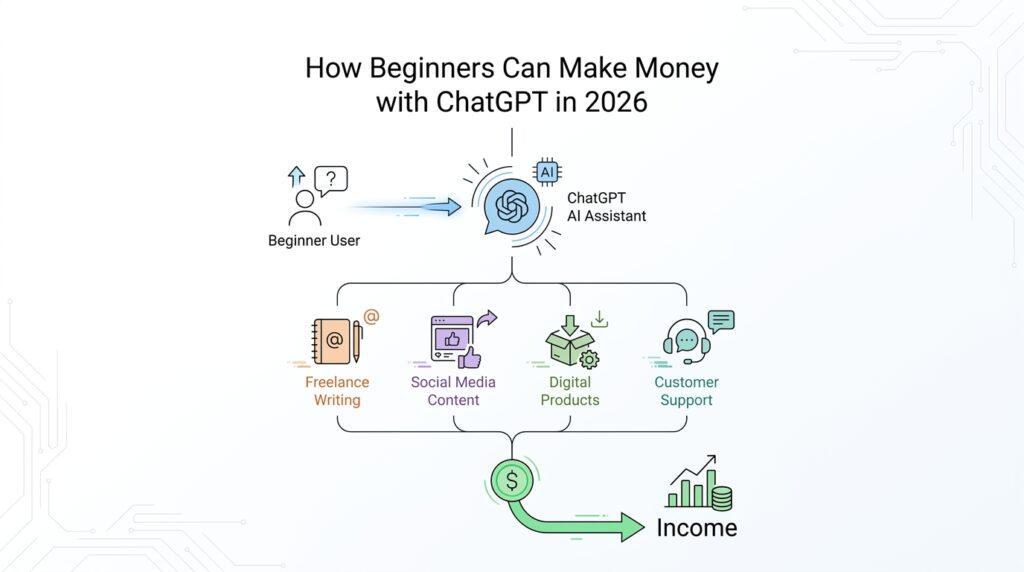
Pick Profitable Beginner Niches
When you first try to make money with ChatGPT, the hard part is usually not writing the prompt—it’s choosing where to point it. The smartest profitable beginner niches are the ones where businesses already spend money on words, because ChatGPT is strongest at helping create, refine, and adapt content like blog posts, webpages, emails, and campaign copy. In other words, we are not hunting for flashy ideas; we are looking for everyday work that repeats, needs speed, and benefits from a clear first draft. That’s why the best beginner opportunities often sit inside content creation, marketing, and customer communication.
What kinds of ChatGPT services are easiest to sell first? Social media content is one of the clearest answers, because it behaves like a river that never stops flowing: posts, captions, hooks, and repurposed ideas keep coming back. OpenAI’s marketing guidance points to first drafts, multi-channel copy, and tone alignment, while Upwork’s marketplace shows active demand for social media content creation jobs and social media content creators. That matters for beginners because this niche rewards consistency more than genius; you can take one idea and reshape it for LinkedIn, Instagram, email, and a blog teaser without starting from zero each time. If you want a practical starting point, this is one of the most profitable beginner niches because the work is easy to explain and easy to repeat.
Email marketing is another strong lane, and it feels a little more like helping someone pack a lunchbox than writing a novel. Mailchimp’s own tools use AI to build email content from prompts, URLs, and source material, and OpenAI describes email campaigns as a natural use case for AI in marketing. That gives you a very beginner-friendly shape of work: you can draft a welcome email, rewrite a sale announcement, or turn a messy product update into a polished newsletter. These services are easier to price than vague “writing help” because the deliverable is concrete, the outcome is visible, and the client can see the before-and-after difference right away.
Ecommerce writing is also worth your attention, especially if you want profitable beginner niches with a simple structure. Shopify explains that a product description tells customers what a product is and why it is worth purchasing, and its guidance encourages sellers to write detailed, SEO-friendly listings or use automatic generation tools when they need help. That makes this niche ideal for ChatGPT, because you can turn feature lists into clear benefits, rewrite manufacturer copy, or build a fuller product page from a few rough notes. The work may look small, but small words can influence buying decisions, which is exactly why store owners pay for it.
A final lane that often gets overlooked is customer communication: FAQ pages, support replies, canned responses, and simple knowledge-base articles. OpenAI’s recent entrepreneurship materials highlight customer communication as an important business use case, and its app examples include drafting updates and reviewing emails to prepare for customer conversations. This is a good niche for beginners because the goal is not poetic writing; it is clarity, speed, and a calm tone that helps people feel understood. If you can take scattered notes and turn them into a friendly reply template or a clean help article, you are already doing work that clients recognize as useful.
As we keep moving, the pattern stays the same: the most profitable beginner niches are usually the ones with a clear audience, repeatable output, and a result that a client can understand in one glance. Once you can spot that shape, it becomes much easier to choose a service, package it cleanly, and start selling with confidence.
Set Up Your ChatGPT Workflow
Now that we have a few profitable beginner niches in view, the next challenge is not creativity but rhythm. A good ChatGPT workflow gives your work a shape, the way a kitchen gives ingredients a place to land before they become a meal. If you are wondering, how do I set up a ChatGPT workflow for beginners?, the answer starts with removing chaos before it starts. We want a repeatable path from client request to polished draft, because the more often you repeat the same steps, the faster you get and the easier it becomes to make money with ChatGPT without feeling scattered.
The first move is to create one home base for every project. This can be a simple document, a notes app, or a spreadsheet, but it should always hold the same pieces: the client’s goal, the audience, the tone, the deadline, and the final deliverable. Think of this like the label on a storage box; once everything has a place, you stop opening the wrong lid. When beginners skip this step, they end up prompting blindly, which makes every task feel new and heavier than it needs to be. A clean setup also helps you reuse ideas later, because your best prompts and best outputs stay easy to find.
From there, we build the workflow around three stages: collect, prompt, and refine. Collect means gathering the raw material first, such as product details, email notes, customer questions, or a rough outline from the client. Prompt means turning that raw material into a clear instruction for ChatGPT, using plain language and a specific outcome instead of a vague request like “write something good.” Refine means checking the output for accuracy, tone, and usefulness, then shaping it into something the client can use. This is the heart of a beginner-friendly ChatGPT workflow, because it keeps you from treating the tool like magic and starts treating it like a drafting partner.
The prompting stage works best when you give ChatGPT a role, a task, and a style target. A role tells it who it is acting as, such as a social media assistant, email copywriter, or customer support writer. The task tells it what to produce, and the style target tells it how to sound, whether that means friendly, concise, confident, or calm. You can think of this like giving directions to a driver: if you only say “go somewhere,” you may end up anywhere, but if you name the destination and the route, the trip becomes much smoother. This is one of the easiest ways to make money with ChatGPT because clearer prompts usually mean fewer rewrites.
Once the first draft appears, the workflow should slow down on purpose. That is the moment to check for missing details, awkward phrasing, and anything that sounds too generic to help the reader. Beginners often want to stop here, but the real value comes from the second pass, when you make the draft feel human and specific. You might swap broad claims for concrete examples, shorten long sentences, or adjust the tone so it matches the client’s brand voice. This refining step is where a simple draft becomes client-ready work, and it is often what separates a hobby prompt from a service someone will pay for.
It also helps to make templates as soon as you notice a pattern. If you write one strong prompt for product descriptions, another for email follow-ups, and another for FAQ answers, you can save each one and reuse it with small edits. That is how a ChatGPT workflow starts to feel less like starting over and more like walking a familiar path with better shoes. You are not trying to memorize everything; you are building a small system that helps you move faster while staying consistent. Over time, that system becomes your quiet advantage, especially when you need to deliver work quickly without losing quality.
The easiest way to stay organized is to end every project by saving what worked. Keep the prompt, the final version, and a short note about what made the result strong, because those three pieces will help you repeat success on the next job. That habit turns each assignment into a lesson instead of a one-time scramble, and it gives your ChatGPT workflow a sense of momentum. Once that rhythm is in place, we can start turning the workflow into something even more practical: a service people can understand, request, and buy.
Offer AI Writing Services
Once your workflow is in place, the next step is to turn that behind-the-scenes practice into AI writing services people can buy. The easiest way to think about it is this: you are not selling ChatGPT, you are selling a result that ChatGPT helps you produce. OpenAI describes common writing tasks like drafting from scratch, rewriting and tightening, adjusting tone for a specific audience, and turning rough notes into clear communication, which is exactly the kind of work a beginner can package and deliver.
That is why the smartest offer is usually narrow. Instead of saying you do “writing,” you might focus on one outcome such as email campaigns, product descriptions, FAQ pages, or social posts. OpenAI’s marketing guidance includes landing pages, email campaigns, ads, product messaging, and executive updates, while Mailchimp shows that AI can build email content from prompts, URLs, and source material. Shopify also frames a product description as the explanation of what a product is and why it is worth purchasing, which makes it a very concrete service to sell.
This is where packaging makes everything feel less mysterious. Upwork’s Project Catalog is built around pre-scoped services with clear pricing, timelines, and deliverables, and its freelancer guidance encourages creators to offer services that can be neatly packaged as fixed-price work. That is a helpful model for beginners because clients can see what they are buying at a glance, instead of trying to guess what “AI writing help” means. You might offer a five-email welcome sequence, ten product descriptions, or a polished FAQ page, each with one clear revision round and one clear deadline.
A good ChatGPT writing service starts with the same raw ingredients every time: the client’s notes, the audience, the goal, and the tone. From there, we ask ChatGPT for a first draft using a role, a task, and a style target, then we move into the part that makes the work feel human. OpenAI’s writing guidance highlights tone adjustment and rewriting as common uses, so your job is to shape the draft until it sounds like it belongs to the client, not to a machine. That second pass is where beginners often gain confidence, because the draft stops feeling like a blank page and starts feeling like clay in your hands.
The real difference between a hobby prompt and a paid service is judgment. You check for accuracy, remove vague phrases, add specifics, and make sure the copy matches the client’s brand voice and business goal. OpenAI’s customer success materials describe the same kind of overhead in another form: pulling context from conversations, turning notes into plans, and writing clear follow-ups that keep everyone aligned. That is a useful reminder that the value is not only in producing words, but in organizing them so the reader can act on them with less effort.
If you want your first offer to feel real fast, build one sample for each service and save the pieces that helped it work. Upwork’s freelancer setup allows you to show text, images, video, and PDF samples in a listing, which is a good reminder that clients buy trust as much as they buy copy. So when you show a before-and-after product description or a cleaned-up email draft, you are not bragging about AI; you are proving that you can turn scattered notes into something useful. That proof is what makes AI writing services easier to sell, easier to repeat, and much easier to improve with every project.
Sell Digital Products Online
After you have a service that works, selling digital products online can feel like the moment the work starts to breathe on its own. Instead of trading every hour for every dollar, you create a file once and let it keep doing its job in the background. That is why so many beginners get excited here: ChatGPT can help you build something useful, polished, and ready to sell without turning the process into a giant project. If you have been wondering, how do I sell digital products online with ChatGPT?, the answer begins with choosing a simple product that solves one clear problem.
A digital product is any downloadable item a customer can use right away, such as a template, planner, checklist, worksheet, prompt pack, or short guide. Think of it like a tool in a digital toolbox rather than a physical box on a shelf. ChatGPT helps most when you use it to shape raw ideas into something organized, because beginners often know the problem they want to solve before they know how to package the solution. We are not trying to invent something huge; we are trying to create something small, focused, and helpful enough that a stranger will gladly pay for it.
The easiest way to start is to build around a pain point people already feel. Maybe they need a content calendar, a job application tracker, a meal planner, a simple onboarding guide, or a set of ready-to-use prompts for their own business. ChatGPT can help you brainstorm product ideas, write the instructions, draft the workbook pages, and even create the sales copy that explains why the product matters. This is where digital products become especially beginner-friendly, because the same tool that helps you make the product can also help you describe it in a clear, human way.
A strong first product usually solves one narrow problem instead of trying to be everything at once. A one-page checklist can be more useful than a sprawling ebook if it helps the buyer take action faster. A template can be more valuable than a long explanation if it saves someone twenty minutes of guessing. ChatGPT is useful here because it can turn a rough concept into an outline, then help you expand each piece until the product feels complete, not flimsy. That is the practical heart of ChatGPT digital products: fast creation, clear structure, and a benefit the buyer can understand in seconds.
Once the product exists, the selling part starts to matter just as much as the writing. We need a simple product page with a title, a short promise, a few benefits, and a preview of what the buyer gets. ChatGPT can draft that page, but you should still read it like a customer who knows nothing about you. Does the wording sound clear? Does it explain the result? Does it answer the silent question every buyer asks: “Why should I choose this one?” A good digital product sells because it feels specific, not because it sounds fancy.
It also helps to think in bundles. One prompt pack can become a larger toolkit. One planner can become a full system with instructions, examples, and a matching tracker. ChatGPT makes this kind of expansion easier because it can keep your style consistent while you build out related pieces. That means you are not always starting from zero; you are growing one small idea into a stronger offer, which is a smart way to make money with ChatGPT without needing advanced design or coding skills.
The final piece is trust. People buy digital products when they believe the product will save time, reduce confusion, or help them reach a result faster than doing it alone. So before you list anything, test the product by imagining the buyer’s first five minutes with it: can they open it, understand it, and use it without feeling stuck? When we build with that kind of care, sell digital products online stops sounding like a vague dream and starts looking like a repeatable system. From here, the next step is learning how to choose the right platform and present the product so the right people can find it.
Create Social Media Packages
Once you have a steady workflow, the next step is giving your work a shape people can recognize and buy. That is where social media packages come in, because a package turns a loose skill into a clear promise. Instead of saying you can “help with posts,” you are saying exactly what someone will get, how often they will get it, and what problem it solves. For a beginner, that clarity is powerful, because clients are far more comfortable buying a simple outcome than guessing what a vague service includes.
Think of a package like a grocery basket instead of a single item on the shelf. A client does not want to assemble every ingredient from scratch; they want the meal plan handed to them in one clean bundle. When you package social media services, you decide the ingredients ahead of time: captions, post ideas, hashtags, content calendars, image prompts, or simple reporting notes. How do you price social media packages when you are just starting out? The safest answer is to price the work you can repeat confidently, not the work you hope you can figure out later.
The easiest packages are the ones built around one clear result. You might offer a weekly content pack, a monthly posting package, or a launch package for a new product or event. Each one should feel small enough to finish without stress, but complete enough that the client can see value right away. This is where ChatGPT becomes especially useful, because it helps you generate first drafts quickly, then adapt them for different platforms like Instagram, LinkedIn, Facebook, or X without starting over each time.
A strong beginner package usually has one main promise and a few supporting pieces. For example, one package could include twelve captions, twelve matching post hooks, and a short content calendar for the month. Another could focus on repurposing a single blog post into a week of social content, which is a great fit if you want to reuse the skills from earlier sections. When you build social media packages this way, you are not selling “words”; you are selling consistency, speed, and relief for a busy business owner who needs content ready to publish.
This also helps you avoid the trap of overpromising. If you offer too much, you end up spending more time editing, chasing missing details, and second-guessing every draft. If you keep the package narrow, you can move faster and deliver cleaner work, which matters a lot when you are still learning. ChatGPT social media packages work best when the scope is small enough that you can check every caption for tone, accuracy, and brand fit without feeling rushed.
To make the offer easier to understand, write it the way a customer would think about it. They are usually asking, “Will this save me time?” “Will this sound like my brand?” and “Will I have to do a lot of extra work after I buy it?” Your package should answer those questions without making people dig for the meaning. That is why simple language wins here: a clear deliverable, a clear timeline, and a clear revision policy make the service feel safer to purchase.
The best part is that each package can become a template for the next one. Once you have one social media package that works, you can adjust the audience, the platform, or the tone and reuse the same structure again. Over time, that turns a one-off offer into a small system, which is exactly what makes beginner income with ChatGPT feel more stable. From here, the natural next move is to learn how to present those packages so they look polished, believable, and ready for clients to choose.
Find Clients And Pitch
At this stage, the work stops feeling abstract and starts feeling real. You have a service, a workflow, and maybe even a digital product or package, but none of that matters until someone actually sees it and says yes. That is why finding clients is the bridge between practice and income, and it is also where many beginners freeze. If you have been wondering, how do I find clients for ChatGPT services?, the answer begins with looking for people who already need words, already feel busy, and already understand that paying for help saves time.
The easiest clients are usually not hidden in some secret corner of the internet. They are already advertising their needs through busy social profiles, outdated website copy, unanswered comments, weak product pages, and awkward emails that do not quite sound like the brand behind them. That is your opening. When you learn to notice those gaps, you stop pitching “ChatGPT” and start pitching relief: clearer copy, faster turnaround, and less stress for someone who has too much to do.
A good beginner search has a simple rhythm. First, choose a small type of business, such as coaches, online shops, local service providers, or creators who post often. Then look for signs that they need help, like inconsistent posting, thin product descriptions, or a website that feels unfinished. Finally, match the offer to the problem instead of trying to sell everything at once. This is where your earlier work pays off, because your service packages give you a clean shape to present instead of a vague promise.
The pitch itself works best when it sounds human, specific, and short. You are not writing a speech; you are starting a conversation. Begin by showing that you noticed something real, then name the result you can help create, and then make the next step easy. A useful pitch often sounds like, “I noticed your product pages could use clearer descriptions, and I can help turn them into copy that explains the benefit faster.” That kind of message feels grounded because it starts with the client’s world, not your own.
Here is the important part: your first pitch does not need to be perfect, but it does need to be relevant. A generic message gets ignored because it could have gone to anyone. A tailored message gets attention because it proves you looked closely enough to understand the business. You can use ChatGPT to draft the first version of your outreach, but you should always edit it so it sounds like a real person speaking to a real person. That small human touch is what separates a ChatGPT pitch from a message that lands in the trash.
When you send your pitch, keep the ask small. Instead of demanding a big commitment right away, offer a sample, a quick audit, or a short starter package that makes the decision feel safe. This is especially helpful for beginners because clients often want proof before they buy a larger service. You might offer to rewrite one email, improve three product descriptions, or draft a week of social posts so they can see the quality before moving forward. Small yeses build trust, and trust is what turns a first conversation into paid work.
The strongest pitches also connect with the problem the client already feels. A busy business owner does not wake up thinking, “I need a ChatGPT assistant.” They wake up thinking, “I need this content finished,” or “I need my emails to sound more professional,” or “I need help staying consistent.” When you frame your message around those outcomes, you make it easier for them to imagine the value. That is why learning to pitch well is such a big part of making money with ChatGPT: the tool may help you create the work, but the pitch helps someone believe the work is worth buying.
Once you start hearing back, the next lesson is patience. Most people will not reply immediately, and some will not reply at all, which is normal rather than discouraging. A polite follow-up can be enough to bring a conversation back to life, especially if your first message was thoughtful and your offer was clear. Over time, you begin to see the pattern: the more specific your outreach, the easier it becomes to find clients, start conversations, and turn your ChatGPT skills into paid work that feels repeatable instead of random.