Question the AI Narrative
If you have spent any time around artificial intelligence news, it can start to feel like the ending has already been written. Every new model launch, every benchmark jump, and every glossy demo seems to point in one direction: more AI, bigger systems, and a future built almost entirely around deep learning. But this is where it helps to slow down and ask a better question: what if that story is only one possible version of the future?
The AI narrative is powerful because it feels obvious. AI means machines that do tasks we usually connect with human thinking, and deep learning means a way of training those machines to recognize patterns from large amounts of data. That combination has produced real breakthroughs, so it is easy to assume the trend will keep climbing in a straight line. Yet technology rarely moves in a straight line for long. What looks inevitable from the outside is often a mix of hype, investment, and a few very visible successes.
Once we notice that, the future of deep learning starts to look less like a parade and more like a negotiation. Some people imagine artificial intelligence becoming the center of everything, from work to education to healthcare. Others expect it to fade into the background, like electricity or Wi‑Fi, where it matters enormously but does not dominate the conversation. That second possibility is easy to miss, but it may be more realistic than the headlines suggest. In that version of the future, AI is still everywhere, yet it stops feeling like the star of the show.
This matters because the most useful technologies are not always the loudest ones. A better map app does not need to advertise the math inside it, and a strong search engine does not need to explain every ranking decision to earn your trust. The same thing could happen with AI systems: they may become smaller, quieter, cheaper, and more specialized. Instead of one giant model trying to do everything, we may see many focused tools working behind the scenes, each one solving a narrow problem well.
So what would challenge the AI narrative? One answer is cost. Training and running large deep learning models takes money, energy, data, and skilled people, and those limits matter when companies move from experiments to everyday products. Another answer is reliability. A system can sound confident and still be wrong, which is a serious problem when the stakes involve medicine, law, finance, or public trust. When you put those limits together, the future of AI looks less like a clean victory lap and more like a series of trade-offs we will keep renegotiating.
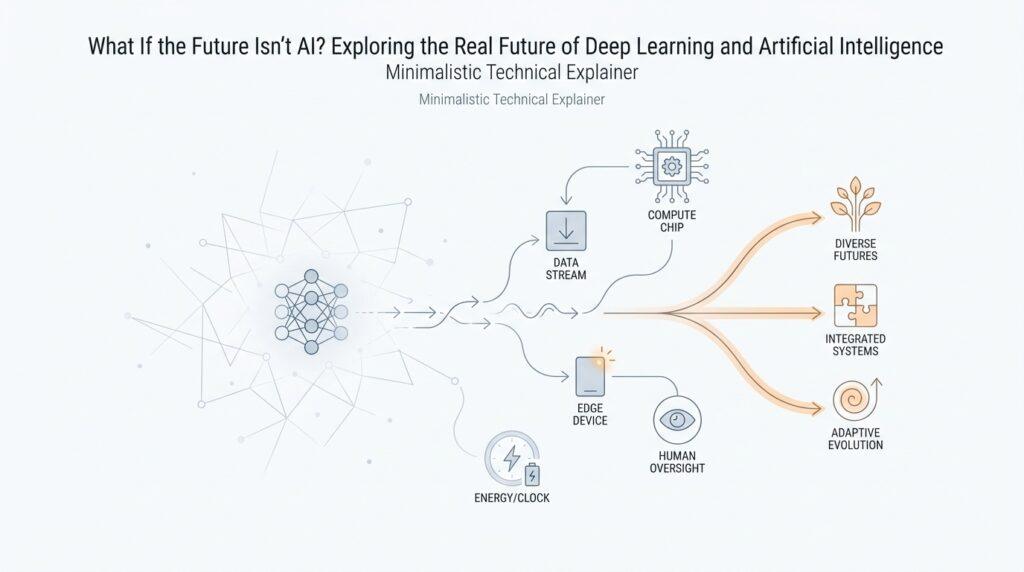
There is also a deeper possibility: the next big shift may not be about making AI larger, but about making intelligence more human-friendly and more context-aware. That could mean deep learning paired with rules, memory, sensors, or human oversight, instead of replacing everything with one giant model. It could also mean new computing approaches, better data systems, or tools that help people think rather than trying to think for them. In other words, the future may belong to hybrid systems, not pure AI.
When we question the AI narrative, we are not rejecting artificial intelligence. We are making room for a broader future in which deep learning is important but not all-powerful, visible but not always central. That shift in perspective matters because it helps us see possibility instead of prophecy. And once we stop treating AI as destiny, we can start asking a more interesting question: what other kinds of intelligence, tools, and systems might shape what comes next?
See Scaling Limits Clearly
Once we slow down and look at deep learning scaling limits, the story changes from “bigger is better” to “bigger only helps when the rest of the system keeps up.” If you have ever watched a suitcase get stuffed until the zipper strains, you have seen the basic problem: a larger container does not solve a packing problem by itself. In AI, more parameters—the parts of a model that store learned patterns—can help, but only when we also supply enough training data and compute, the raw machine power used to train the model. What do scaling limits actually look like in deep learning? They look like the point where growth starts asking for more than the pipeline can comfortably give.
The clearest lesson from scaling laws is that size and data need to move together. In the Chinchilla study, researchers found that many large language models were undertrained because people kept enlarging models without increasing the training tokens—the chunks of text used for training—at the same pace. Their compute-optimal rule was wonderfully plain: if you double model size, you should also roughly double the training tokens. That does not mean large language models are a dead end; it means the fastest route forward is balance, not brute force.
This is where the phrase scaling limits becomes useful rather than gloomy. A model can keep getting larger and still give smaller gains for the same extra effort, which is another way of saying the next improvement may cost much more than the last one. Compute trends in machine learning have risen quickly over time, and those rising demands are one reason the field keeps running into trade-offs between ambition, budget, and engineering reality. When progress depends on ever-larger training runs, deep learning starts to resemble a luxury car that can go fast but becomes expensive to maintain.
But size is only one side of the ceiling. Reliability matters too, because a system can sound polished while still making up facts or missing the user’s intent. The InstructGPT paper showed that making language models bigger did not automatically make them better at following instructions; in fact, a 1.3B model trained with human feedback was preferred to a 175B GPT-3 model in human evaluations, even though it had far fewer parameters. That is a huge clue: the future of deep learning is not just about scale, but about shaping behavior with better supervision, feedback, and alignment.
Once we see the limits clearly, the future starts to look more hybrid than heroic. Instead of one giant model trying to do everything, we are likely to get systems that mix deep learning with retrieval, rules, memory, and human oversight, because those parts can cover for the blind spots that scaling cannot erase. This is an inference from the scaling and alignment results above, but it fits the pattern: when raw size stops paying for itself, the smartest move is to improve the surrounding system. In practical terms, the next leap may come from better data curation, smarter training recipes, and narrower models that are built for a job rather than for applause.
That is why seeing scaling limits clearly is so useful for anyone trying to understand the AI future. It keeps us from mistaking a steep trend line for destiny, and it helps us notice where deep learning is powerful, where it is strained, and where other approaches may quietly take over some of the work. The story is not that AI stops growing; it is that growth may become more selective, more disciplined, and more dependent on the system around the model than on the model alone.
Blend Learning With Reasoning
After we notice the scaling limits, the next question almost asks itself: if bigger deep learning runs stop delivering effortless gains, where does progress come from? The answer is often a blend of learning with reasoning, a hybrid approach where an AI system learns patterns from data but also uses structured steps, outside knowledge, or tools when the problem asks for more than pattern matching. Think of it like giving a traveler both a strong memory and a map; one helps with familiar streets, the other helps when the road gets messy. Research on modular, neuro-symbolic systems frames this as a systems problem, not a single-model contest.
That distinction matters because learning and reasoning solve different parts of the puzzle. Deep learning is excellent at absorbing examples and spotting regularities, but the InstructGPT work showed that making a language model bigger does not automatically make it better at following human intent; the breakthrough came from fine-tuning with human feedback, and a 1.3B model was preferred over a 175B GPT-3 model in human evaluations. In plain English, the model needed guidance about how to behave, not only more capacity to store patterns. OpenAI’s alignment research makes the same point: human feedback can improve usefulness, truthfulness, and instruction-following without relying on size alone.
Once you start thinking this way, retrieval becomes the model’s notebook. Retrieval-augmented generation, or RAG, means the system looks up external documents and folds them into the answer instead of relying only on what it memorized during training. In the Active Retrieval Augmented Generation paper, FLARE goes one step further by deciding during generation when to retrieve new information, which helps long-form text stay grounded and reduces hallucination, the term for confident-sounding but false output. For a reader, the takeaway is simple: the AI future may reward models that know when to consult the shelf.
Tools push the idea even further. Toolformer showed that language models can learn, in a self-supervised way, when to call APIs such as a calculator, search engine, or calendar, and ReAct interleaves reasoning traces with actions so the model can update its plan while gathering new information. That combination matters because reasoning without action can drift into guesswork, while action without reasoning can become a pile of random lookups. When we blend learning with reasoning, we get a system that can think, check, and then think again.
This is where hybrid AI starts to look less like a compromise and more like common sense. MRKL describes a modular, neuro-symbolic architecture that pairs neural models with discrete knowledge and reasoning modules, which is another way of saying that one component can do the language heavy lifting while another handles logic, retrieval, or decision steps. What is hybrid AI if not a division of labor? Instead of asking one model to be an encyclopedia, calculator, and planner all at once, we let each part do the job it handles best.
The big shift, then, is not from AI to no AI, but from isolated models to systems that learn, reason, retrieve, act, and defer to humans when needed. That is an inference from the papers above, but it fits the direction they point toward: better answers come from better orchestration, not just bigger weight counts. If you are trying to picture the future of deep learning and artificial intelligence, imagine less magic and more choreography, with the model as one skilled performer in a much larger cast.
Shift Intelligence On-Device
After we have stared at scaling limits for a while, the next turn in the story feels almost quiet: intelligence starts moving closer to the person using it. On-device AI means the model runs on your phone, laptop, watch, or another local device instead of sending every request to a distant server. That shift matters because it changes the pace, the privacy story, and even the shape of the product itself. When people search for on-device AI, what they usually want to know is this: why move intelligence onto the device at all? The short answer is that local processing can make AI faster, more private, and more useful in places where the cloud is a poor fit.
Once we see that, the trade-off becomes easier to picture. A cloud model is like calling a distant expert for every question, while on-device intelligence is more like keeping a skilled helper at your elbow. The helper can respond quickly, keep sensitive information nearby, and keep working even when the connection is weak or missing. Apple describes on-device processing as the foundation of its Apple Intelligence system, while Google AI Edge positions its stack around low-latency, high-privacy deployment across devices.
That local-first design also explains why the cloud does not disappear. Some tasks are simply too large, too power-hungry, or too memory-heavy for a pocket-sized device, and Apple’s own developer guidance says server-based models still make sense when a problem needs more memory and power than a device usually has. In other words, the future is not a clean replacement; it is a handoff. The device handles the everyday moments, and the cloud steps in when the request becomes too heavy for the hardware in your hand.
What does on-device AI look like in practice? It often shows up first in familiar features that feel almost invisible: dictation that works offline, image and scene recognition that happens on the phone itself, and predictive text that learns from your behavior without turning every keystroke into a server request. Apple’s privacy materials point to these kinds of on-device features, and Google’s on-device stack now includes support for running generative AI locally, even entirely offline in some demos. That is the real clue here: on-device AI is not a futuristic gadget trick, but a way of making common tasks faster and less exposed.
To make that possible, engineers have to reshape the model for the device. They convert models into deployment-friendly formats, lean on hardware acceleration, and let CPUs, GPUs, and NPUs, or neural processing units, share the work. Google’s LiteRT framework is built for that kind of on-device machine learning deployment, and its docs emphasize support for converting models and optimizing them for edge platforms. This is where the deep learning story gets more practical: the winning system is not always the biggest model, but the one that can run where the user actually is.
That is why the move toward on-device intelligence feels so important. It pushes AI away from the drama of huge centralized systems and toward quieter, more context-aware tools that fit into daily life. It also gives us a better pattern for the future of deep learning: smaller models, smarter deployment, and more careful choices about what should stay local and what should travel to the cloud. Once we start looking at AI this way, the question changes from “How big can the model get?” to “Where should intelligence live, and what should it be allowed to know?”
Build Trustworthy AI Systems
When you move from a clever demo to a system people rely on, the question changes from “Can it work?” to “Can people trust it when it matters?” That is the heart of trustworthy AI systems: NIST describes trustworthiness through valid and reliable behavior, safety, security and resiliency, accountability and transparency, explainability and interpretability, privacy, and fairness with harmful bias managed. In practice, that means we are not building a magic trick; we are building a tool that should stay useful when the room gets noisy, the data shifts, or the stakes rise.
The easiest way to think about the AI Risk Management Framework, or AI RMF, is as a map for the whole journey. NIST says the framework is voluntary and meant to help organizations design, develop, use, and evaluate AI products, services, and systems with trustworthiness in mind. That matters because trustworthy AI is not a single test you pass once; it is a set of decisions you make early, then revisit as the system grows. If you are wondering, “How do you build trustworthy AI systems without getting lost?”, the answer starts with asking about risk before the model is already in the wild.
Before launch, we need to stress the system the way a bridge is tested before cars cross it. NIST treats evaluation, benchmarking, and red teaming as part of the work of making AI trustworthy, and it defines red-teaming as structured testing to find flaws and vulnerabilities in an AI system. Documentation helps too: Google DeepMind’s model cards are meant to spell out known limitations, mitigation approaches, and safety performance so people can see where a model is strong and where it is not. That combination—tests plus honest notes—keeps us from confusing a polished demo with a dependable system.
Then comes the part many teams underestimate: life after launch. NIST’s AI research portfolio emphasizes measurements, evaluations, benchmarks, and test methods, which is a strong hint that trustworthy AI systems need ongoing checking, not only a one-time review. We can think of this as watching for behavior that changes as real-world inputs move away from the training set, and for security problems that appear only under pressure. In other words, a trustworthy AI system is not frozen in time; it stays trustworthy by being measured, re-measured, and corrected.
When we put all of this together, the picture becomes less glamorous and much more useful. Trustworthy AI systems are built by narrowing surprises: we define the job, test against clear benchmarks, document limitations, keep an eye on behavior after release, and design the system so people can understand what it is doing and why. That is not a rejection of deep learning; it is the step that lets deep learning earn a place in serious products. If the future belongs to AI at all, it will belong most to the systems that stay clear-eyed about their limits.