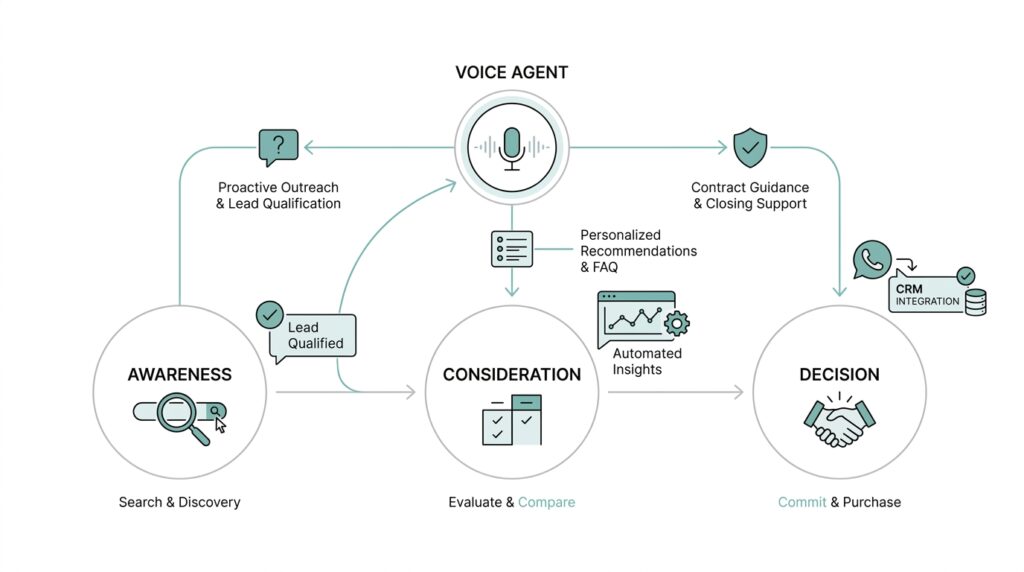
Map the Buyer Journey
If we’re trying to make sense of the B2B buyer journey, the first thing to notice is that it rarely looks like a straight road. It looks more like a series of detours: a website visit, a phone call, a demo request, a video meeting, then another call when a new stakeholder appears. Recent B2B research shows buyers use an average of ten interaction channels during one journey, and they want to move between digital, remote, and human touchpoints without friction. That is why buyer journey mapping matters so much here: it helps us see where people are getting answers, where they’re getting stuck, and where a voice agent can step in without making the experience feel disjointed.
Once we stop thinking of the journey as linear, the next piece comes into focus. In B2B, buyers tend to cycle through a set of repeating jobs: identifying a problem, exploring options, defining requirements, narrowing suppliers, validating the choice, and building consensus across the team. That looping pattern is the heart of the B2B buyer journey, because the same question can reappear in a new form once legal, finance, or technical stakeholders join the conversation. So when we map the journey, we are not drawing one path; we are tracing the moments when the buyer needs confidence, speed, or reassurance.
This is where voice agents become especially useful. A voice AI agent can answer the phone, capture intent, handle routine questions, and then escalate to a human agent when the conversation needs judgment or nuance. Zendesk describes this as end-to-end voice automation with a seamless handoff that carries context, transcription, and conversation history into the human workspace, which is exactly what a buyer needs when they refuse to repeat themselves for the third time. In practical terms, that means the voice agent is not replacing the relationship; it is protecting it by taking care of the repetitive first steps.
If you’ve ever wondered, “What should I map first in the buyer journey?” the best answer is often the questions buyers ask out loud. Calls are rich because they reveal urgency, objections, and missing information in a way that forms and page views often do not. HubSpot’s conversation intelligence tools are built around that idea: bringing customer voice into the CRM, surfacing insights from calls, and helping teams spot patterns, objections, and coaching opportunities. When we connect those call insights to the journey map, we start seeing which stage needs faster routing, which stage needs better information, and which stage needs a human follow-up.
A useful way to build the map is to start with entry points instead of departments. We can mark every place a buyer might begin: a missed call, a pricing question, a demo request, a callback after a webinar, or a transfer from an account executive. Then we ask one simple question at each point: what decision is the buyer trying to make right now? That question keeps the map centered on the buyer’s job, not our internal org chart, and it helps us place voice agents where they reduce friction instead of adding another layer of automation.
As the map becomes clearer, the pattern usually feels less mysterious. Voice agents work best at the edges of the journey, where speed, availability, and consistency matter most, while humans shine in the moments that require trust, negotiation, and cross-functional alignment. Intercom’s guidance on voice AI says the strongest deployments are the ones that define where AI ends and human judgment begins, and that is the real payoff of buyer journey mapping: we stop guessing and start designing handoffs on purpose. Once we can see those moments clearly, the rest of the sales experience becomes easier to shape.
Spot High-Intent Touchpoints
Now that we can see the journey as a set of stops, the next question is more practical: which of those stops actually signal that a buyer is ready to move? That is where high-intent touchpoints matter. A high-intent touchpoint is any moment when the buyer’s behavior suggests urgency, comparison, or readiness to act, like asking about pricing, requesting a demo, or calling back after going quiet. In the B2B buyer journey, these moments are often small on the surface but loud in meaning, and voice agents are especially useful because they can catch the signal while it is still fresh.
The easiest way to think about intent is to picture a store aisle. Some people are browsing, some are comparing two products, and some are already holding a basket and looking for checkout. In B2B, those three states can sound similar unless we listen closely. A casual question might sound like research, but a call that includes budget, timeline, approval, or integration details usually points to stronger buying intent. When we spot those patterns early, we can respond to the buyer’s real pace instead of treating every interaction as if it means the same thing.
So where do high-intent touchpoints show up in the B2B buyer journey? They usually appear when the buyer moves from learning to narrowing. A pricing page visit followed by a call, a webinar attendee asking how implementation works, or a procurement contact requesting legal documentation all suggest the conversation is getting serious. The important part is not the channel itself; it is the decision pressure behind it. One buyer may ask a simple question because they are curious, while another asks the same question because they are one approval away from choosing a vendor.
Voice agents help us spot that difference because they hear the words people use, not just the pages they click. They can notice phrases like “Can you send over a quote?”, “Who do I speak with about rollout?”, or “We need this in place this quarter,” then surface those moments for follow-up. That matters because intent often hides inside everyday language. A contact form can tell us someone reached out, but a voice interaction can tell us whether they are window-shopping or preparing to buy.
The strongest high-intent touchpoints also show up when the buyer starts looping in other people. When finance, legal, IT, or operations joins the conversation, the stakes usually rise, because now the buyer is not only asking whether the product works, but whether the organization can agree on it. This is one reason voice agents are so valuable in the buyer journey: they can capture the first clue, route it to the right person, and preserve the context so no one has to start from scratch. In that moment, the voice agent acts like a good usher at a busy theater, guiding the right person to the right seat without making the audience wait.
If we want to make this practical, we start by asking what changes when intent increases. Does the buyer ask for a faster response? Do they mention a deadline, a team, or a competitor? Do they move from general curiosity to specific conditions? These shifts are small, but together they create a pattern. Once we train ourselves to notice them, we stop mistaking noise for opportunity and start seeing the high-intent touchpoints that deserve immediate attention.
That is also where scoring and routing become useful. When a voice agent captures a high-intent signal, it can tag the conversation, enrich the record, and send it to the right rep before the moment cools off. This does not mean every urgent-sounding call becomes a sales-ready lead, but it does mean we can treat the B2B buyer journey with more precision. The goal is to meet the buyer at the exact point where interest becomes action, because that is usually where momentum either grows or disappears.
Once we learn to spot these moments, the map starts to feel alive. We are no longer looking at a list of channels; we are watching the buyer’s confidence build, pause, and tip forward. That is the real value of high-intent touchpoints: they tell us when to listen harder, when to respond faster, and when a voice agent should step in as the first helpful hand on the line.
Qualify Leads by Voice
When the phone rings, the qualification process has already started. A good voice agent can greet the caller, capture why they reached out, and pass the conversation along with context instead of making them repeat themselves from scratch. That matters because Zendesk’s voice AI agents are designed for end-to-end call handling with seamless escalation, and Intercom’s voice tooling also emphasizes full-context handoff when human help is needed. In other words, when we qualify leads by voice, we are not replacing the sales conversation; we are making the first minute of it count.
The easiest way to think about this is to picture a first meeting that starts with listening, not interrogating. If we ask too many questions too soon, the call can feel stiff and transactional, but if we answer first and then ask for the next useful detail, the exchange feels natural. Intercom’s guidance on lead qualification explicitly recommends answering the lead’s question before asking your own and only asking questions that help determine fit, while HubSpot’s conversation intelligence tools focus on bringing the voice of the customer into the CRM so teams can see patterns and objections more clearly. So how do you qualify leads by voice without making the call feel like a checklist? We keep the conversation helpful, brief, and tied to the buyer’s actual next step.
Once that rhythm is in place, the real clues become easier to hear. In B2B sales, those clues often sound like budget, authority, need, and timeline, which is the classic BANT framework HubSpot still uses as a reference point for sales qualification. A caller asking about pricing, implementation, approval steps, or launch timing is usually telling us more than they realize. Intercom’s qualification setup also supports collecting specific data points such as company size or other custom details, which helps a voice agent turn a loose conversation into a usable lead profile.
That is why voice is such a strong channel for lead qualification: people say the useful stuff out loud before they organize it into a form. A rep or voice agent can hear, “We need this live next quarter,” or “Our IT team needs to review it,” and treat those phrases as signals, not small talk. HubSpot’s conversation intelligence product is built around capturing voice data, surfacing top objections, and revealing performance patterns, which is exactly the kind of input we want when deciding whether a lead is warm, ready, or still researching. The call becomes a live signal stream, not just a record of contact.
The practical workflow is simple to imagine even if the technology behind it is not. First, the voice agent answers the common question or collects the caller’s intent. Then it asks for only the information that changes the next action, such as company size, timeline, or team involvement, instead of piling on every possible qualification question. Intercom’s lead tools and workflows are built around that same idea of collecting just enough qualifying data and then routing the lead to the right team or follow-up action. That is the heart of qualify leads by voice: answer, listen, capture, route.
From there, scoring and routing become much more useful. When a voice agent captures a serious buying signal, it can tag the conversation, enrich the lead record, and move it to the right rep before the moment cools off. Zendesk and Intercom both stress the importance of preserving transcripts, summaries, and context for smooth handoffs, because that context helps humans continue the conversation without losing momentum. We are not trying to qualify every caller into a perfect sales-ready lead; we are trying to recognize when curiosity has turned into motion and respond at the right speed.
That is the real payoff. When voice agents handle the opening stretch well, the sales team gets cleaner signals, better context, and fewer dead-end conversations, while the buyer gets a faster, more human-feeling experience. The B2B buyer journey starts to feel less like a maze of missed handoffs and more like a guided path where the right people show up at the right moment. Once we can see that first call clearly, the next challenge is making the handoff feel just as thoughtful as the qualification itself.
Book Demos Instantly
Once a lead feels warm, the clock starts ticking. The buyer has momentum, the rep has context, and the worst thing we can do is make that person wait three emails and a calendar puzzle before they can see the product. This is where voice agents make it possible to book demos instantly, turning interest into a scheduled meeting while the conversation is still fresh. In the B2B buyer journey, that speed matters because the moment a buyer raises their hand, their attention is already competing with meetings, deadlines, and other vendors.
The real win here is not speed for its own sake. It is reducing the little moments of friction that quietly drain intent, like asking someone to search for a booking link, check time zones, or wait for a rep to reply later. A voice agent can handle demo scheduling in the same breath as qualification, which feels more like a helpful concierge than a handoff into a queue. When the buyer hears, in plain language, that a meeting can be set up right now, the experience feels responsive and human.
How do you book demos instantly without making the process feel robotic? The answer is to let the voice agent gather only the details that affect the meeting itself. That might include the buyer’s name, company, preferred timing, and whether they need one person or a group on the call. From there, the agent can check availability, offer the next best slot, and confirm the time before the caller hangs up, which keeps the B2B buyer journey moving instead of pausing at the finish line.
This also works well because buyers often have a very specific window of interest. Maybe they are comparing vendors this week, maybe they have internal approval next Tuesday, or maybe they are trying to get a demo on the calendar before a budget meeting. If we wait too long, that urgency cools down. If we book the demo instantly, we meet the buyer at the exact point where curiosity becomes action, and that is usually where the strongest opportunities live.
Voice agents also help us handle the practical messiness that often slows demo booking down. Time zones can be confusing, teams may need different attendees, and some buyers want a sales engineer present while others want a simple overview. Instead of forcing the buyer to sort all of that out alone, the voice agent can ask a few focused questions, route the request to the right rep, and preserve the context for the meeting invite. That kind of guided scheduling feels small, but it removes one of the biggest hidden obstacles in the B2B buyer journey.
There is another quiet advantage here: consistency. Human teams are great, but they are not always available at the exact moment a buyer calls, and missed calls can turn into missed demos. A voice agent can answer after hours, capture the request, and hold the conversation together until the meeting is confirmed, which means the buyer does not have to start over the next day. In practice, that makes demo booking feel less like a sales process and more like a service the buyer can rely on.
Once the demo is on the calendar, the job is not over. A good voice agent can confirm the meeting details, send a reminder, and make rescheduling easier if plans change, which they often do in B2B buying. That follow-through protects the momentum we worked so hard to build in the first place. So when we talk about booking demos instantly, we are really talking about keeping the buyer’s energy intact from first signal to confirmed meeting, and that is what turns a promising call into a real sales opportunity.
Personalize Buyer Conversations
The moment a buyer answers the phone, the conversation has already begun to reveal who they are and what they need. That is why personalized buyer conversations matter so much in the B2B buyer journey: people do not want to feel like ticket numbers, and they especially do not want to repeat the same backstory every time they move between channels. A voice agent can help here by remembering the thread of the conversation, pulling in context from earlier touchpoints, and shaping the next question around what the buyer has already told us. When we do that well, the exchange feels less like a script and more like a guided conversation.
Personalization starts with small, thoughtful signals. A voice agent can greet someone by name, recognize whether they are a first-time caller or a returning lead, and adjust its tone based on where they are in the buying process. If someone has already asked about pricing, the next conversation should not restart with broad discovery; it should move toward budget, timing, or next steps. That kind of responsiveness is what makes voice agents useful in the B2B buyer journey, because the buyer feels seen before they are asked to explain themselves again.
How do you personalize buyer conversations without making them feel scripted? The answer is to let context do the heavy lifting. Context is the information that gives a conversation meaning, like a recent demo request, a product page visit, or a prior call summary stored in the CRM, which stands for customer relationship management system. When a voice agent uses that context, it can ask better follow-up questions, avoid repetitive intake, and sound more like a helpful assistant than a call tree. Even a simple line such as “I see you were looking at implementation options yesterday” can change the tone of the entire exchange.
This is where conversation memory becomes especially valuable. Conversation memory means the system can retain important details from earlier interactions and use them later, so the buyer does not have to start over each time. Imagine walking into a store where the associate already remembers what you were comparing last week; that is the feeling we want to create here. In a B2B setting, that might mean remembering the team size, the use case, or the concern about rollout speed, then using those details to steer the conversation in a way that feels natural.
The best personalized buyer conversations also respect the difference between information and intent. A buyer who asks a general question is usually still exploring, while a buyer who mentions deadlines, approval steps, or implementation concerns is signaling urgency. Voice agents can listen for those clues and adapt in real time, which helps us match the pace of the conversation to the buyer’s actual readiness. That matters because personalization is not about sounding clever; it is about responding in a way that makes the buyer’s next decision easier.
We also personalize better when we stop treating every buyer the same after the first touchpoint. A returning prospect, a champion who is gathering information for a team, and a procurement contact all need different kinds of help, even if they are asking about the same product. Voice agents can use routing rules, shared notes, and prior interactions to distinguish those situations and shape the conversation accordingly. In practice, that means a voice agent can warm up a returning buyer with relevant context, while still keeping the exchange concise and useful.
The real payoff shows up when personalization leads to trust. Buyers are far more likely to keep talking when they feel the system understands their situation, remembers their preferences, and does not waste their time. That is one reason voice agents are such a strong fit for personalized buyer conversations in the B2B buyer journey: they can combine speed with memory, and efficiency with a more human feel. Instead of forcing the buyer to fit the process, we let the process bend around the buyer.
Over time, those small moments add up. A tailored greeting, a better follow-up question, a reminder of an earlier concern, or a handoff that preserves context can make the whole buying experience feel smoother and more respectful. That is how personalized buyer conversations move from being a nice-to-have into a real advantage, because they help us meet people as individuals while still keeping the sales process moving forward.
Measure Conversion Impact
After we’ve mapped the journey, captured intent, qualified the lead, and booked the demo, the next question becomes the one every team eventually asks: how do we measure whether voice agents are actually improving conversion impact? The cleanest place to start is the pipeline itself. HubSpot’s sales analytics and funnel reporting focus on how prospects move from one stage to the next, which makes conversion rate a practical way to see whether your voice agent is helping more buyers reach the next step instead of stalling out. In other words, we are not measuring activity for its own sake; we are measuring movement.
The first signal to watch is speed, because momentum often disappears in the gaps. Zendesk’s voice AI agents are built to handle calls end to end and pass full context, transcription, and conversation history to human agents when escalation is needed, while Intercom says the strongest phone workflows define clearly where AI ends and human judgment begins. That means a voice agent’s conversion impact is not only about answering more calls; it is also about shortening the time between first interest and a useful next step. When the handoff feels seamless, the buyer does not have to restart the story, and that alone can protect the deal from going cold.
From there, we can look at call quality, not just call volume. HubSpot’s Conversation Intelligence brings customer voice into the CRM and surfaces call insights, objections, and performance patterns, which is exactly the kind of evidence we need when we want to compare “before voice agent” and “after voice agent” behavior. If more conversations are producing clear next steps, richer objection data, and cleaner records, that is a strong sign the voice agent is improving conversion impact in the buyer journey rather than merely collecting noise. We start to see whether the buyer is curious, qualified, or ready to move, instead of treating every call like the same kind of lead.
The next layer is lead quality, because a faster pipeline is not helpful if it fills up with the wrong prospects. Intercom’s lead-qualification guidance is built around a simple idea: answer the lead’s question first, then ask only the questions that help you understand fit. That gives us a useful measurement lens. If the voice agent is working well, we should see more complete qualification data, fewer abandoned conversations, and better lead-to-meeting conversion without making the experience feel like an interview. The question many teams search for is this: what metrics show that voice AI is improving lead quality? The answer usually lives in the combination of qualification completion, routing accuracy, and meeting conversion.
We also want to measure what happens after the meeting is booked, because conversion impact does not stop at the calendar invite. HubSpot’s attribution reporting shows that revenue analysis depends on linked interactions, contacts, and deals, which means the best view of impact comes when call, meeting, and deal data all live in the same record. If voice-sourced conversations are associated with more closed-won deals, fewer no-shows, or faster progression through the pipeline, that is where the real story emerges. The point is not to prove that every voice interaction becomes revenue; it is to show that the voice agent is helping more of the right opportunities survive the journey.
A helpful way to think about this is to compare assisted paths and unassisted paths. One path might be a buyer who calls, gets qualified, books instantly, and receives a clean handoff; another might be a buyer who fills out a form, waits, follows up twice, and loses interest before anyone responds. Zendesk’s voice automation and Intercom’s AI-human workflow both emphasize preserved context and thoughtful transfer, because those are the moments that keep a conversation alive. When the assisted path consistently produces faster meetings, stronger qualification, and better downstream conversion, we have a measurable conversion impact we can trust.
That is why the best measurement framework stays simple, even if the technology behind it is not. We look for fewer dropped calls, faster routing, stronger lead-to-meeting rates, better stage-to-stage movement, and more revenue tied back to conversations that the voice agent touched. When those numbers improve together, the buyer journey feels smoother because the system is removing friction at the exact moments when interest is most fragile. And that is the real sign we are looking for: not just more conversations, but more conversations that keep moving toward a decision.