Understand the Three Terms
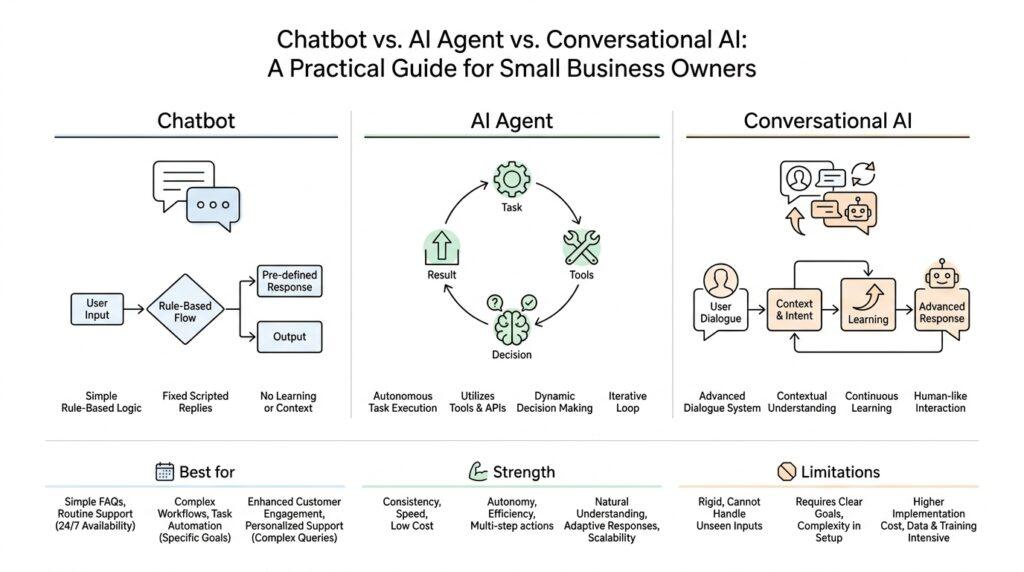
If you’ve ever opened a business website and chatted with a little message box asking how it can help, you’ve already met the first character in this story: a chatbot. A chatbot is a program that responds to messages, usually by following a set of rules or a narrow script. An AI agent goes a step further, because it can take action toward a goal, not only reply to a question. And conversational AI is the wider umbrella term for systems that use artificial intelligence to talk with people in a natural, back-and-forth way.
That distinction matters more than it first appears, especially when you’re trying to choose the right tool for a small business. What is the difference between a chatbot and an AI agent? Think of it like this: a chatbot is the helpful receptionist who answers the phone with prepared responses, while an AI agent is the assistant who can also check the calendar, update the record, or send the follow-up email. Conversational AI is the style and capability that makes the interaction feel human-like, even when the system behind it is simple or advanced.
A chatbot usually lives in a small, defined space. It might answer common questions, guide someone to a support article, or collect a name and email address. Because it works within clear boundaries, a chatbot is often easier to set up and safer to use for routine tasks. For many businesses, that is enough to reduce repetitive work and keep customers moving without long waits.
An AI agent is different because it can do more than talk. It can reason through a task, choose a next step, and connect with other tools or systems to complete part of the job. If the customer asks for a refund status, the agent may check an order system, confirm the details, and prepare a response instead of only pointing the customer to another page. That makes an AI agent feel less like a script and more like a digital coworker, although it still needs clear limits and oversight.
This is where conversational AI can create confusion, because people often use the term as if it means the same thing as chatbot. In practice, conversational AI describes the communication layer: the part that understands language, responds naturally, and keeps the exchange flowing. A chatbot can use conversational AI, and an AI agent can use it too. So when you hear the phrase, picture the speaking ability itself, not necessarily the full system behind it.
The easiest way to keep the three terms straight is to ask what the system is meant to do. If it mainly answers questions, you’re probably looking at a chatbot. If it can decide and act across tools, you’re probably looking at an AI agent. If the focus is on natural dialogue, then you’re in conversational AI territory. That mental model helps because the labels overlap, but the job each tool performs does not.
For a small business owner, the practical difference is about scope and risk. A chatbot can handle FAQs, appointment requests, and basic lead capture with very little complexity. An AI agent can support more complex workflows, but it also needs better guardrails because it may touch customer data, business systems, or actions that affect real outcomes. Conversational AI can improve the experience in both cases by making the exchange feel smoother, faster, and more personal.
So as we move forward, it helps to remember that these are not competing buzzwords so much as layers of capability. A chatbot is often the starting point, conversational AI is the communication experience, and an AI agent is the system that can move from conversation into action. Once you can see those roles clearly, the rest of the comparison becomes much easier to follow.
Compare Core Capabilities
When you begin comparing chatbot vs AI agent vs conversational AI, the real question is not what they are called, but what they can do the moment a customer sends the first message. A business owner usually cares about the job getting done: answering a question, booking a time, checking an order, or passing the conversation to a person when things get messy. That is where the differences start to matter, because each tool handles pressure in a different way.
A chatbot is strongest when the path is clear and the choices are limited. It can recognize a common request, match it to a prepared answer, and move the conversation along without much drama. Think of it like a store associate standing at a welcome desk with a binder of approved responses. That makes a chatbot excellent for FAQ support, simple lead capture, and appointment requests, but it is less comfortable when the conversation bends into unusual territory or the customer asks for something outside the script.
An AI agent has a broader range because it can do more than reply. It can take a goal, break it into steps, and connect with tools such as calendars, databases, email systems, or order platforms. If a customer asks, “Where is my refund?” the AI agent may look up the order, check the status, and prepare the next action instead of only pointing the person toward a support page. That extra reach is the key difference: the AI agent is built for action, not only conversation.
Conversational AI sits in a different layer, and that is why it can be confusing at first. It describes the language experience itself: the ability to understand natural wording, keep the exchange flowing, and respond in a way that feels less mechanical. In other words, conversational AI is the voice and listening skill, while the chatbot or AI agent is the worker behind that voice. You can have conversational AI inside a chatbot, inside an AI agent, or inside both, which is why the terms often overlap in real products.
If you are asking, “What can a chatbot do versus an AI agent for my business?” the practical answer comes down to three things: context, action, and flexibility. A chatbot handles short, predictable conversations well, but it usually works best when each message can be treated on its own or with only a small amount of memory. An AI agent can keep more context in play, remember the goal, and decide what to do next across systems. That makes it better suited for multi-step work, especially when the answer depends on more than one piece of information.
We also need to think about control, because capability without limits can become risky. A chatbot is usually easier to supervise because it stays inside a narrow lane. An AI agent can save more time, but it also needs guardrails because it may touch customer data or make changes in business tools. Conversational AI can make both experiences feel smoother and more human, yet a polished conversation does not automatically mean the system is safe, accurate, or ready to act on its own.
So when we compare chatbot vs AI agent vs conversational AI, we are really comparing three different strengths that can work together. A chatbot is the reliable front desk, conversational AI is the natural-sounding conversation, and an AI agent is the part that can carry the task forward. Once you see those capabilities side by side, choosing the right tool becomes less about buzzwords and more about the kind of work you want handled.
Match Tools to Tasks
Now that we can tell the characters apart, the next question is the one that matters in real life: what problem are we trying to solve first? That is where the choice between chatbot, AI agent, and conversational AI becomes practical instead of abstract. If you own a small business, you are not buying a label—you are choosing a tool that should fit a specific kind of work, like a key cut for a single lock. When we match tools to tasks, we stop asking which option sounds smartest and start asking which one will quietly save time, reduce friction, and keep customers moving.
The easiest place to start is with repetitive questions that show up all day long. If customers keep asking about store hours, service areas, return policies, or basic pricing, a chatbot is usually the best match because it can answer the same thing consistently without getting tired. Think of it like a front desk sign that can talk back: it gives the same clear directions every time, and that consistency is exactly what makes it useful. For FAQ support, lead capture, and simple appointment requests, a chatbot often does the job with far less setup than a more advanced system.
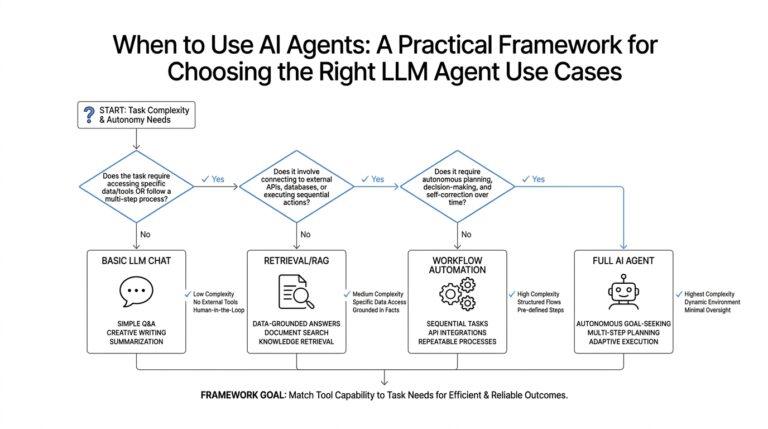
Once the task starts involving more than one step, we begin to leave chatbot territory and move toward an AI agent. This is where the conversation is no longer only about answering; it is about doing. A customer might ask for an order update, a booking change, or a refund status, and the system may need to check one tool, verify information in another, and prepare the next action. If you have ever wondered, “What should I use when the work needs both conversation and action?” that is often the moment when an AI agent makes more sense than a chatbot.
A helpful way to think about this is to picture a simple path versus a winding path. A chatbot is strongest on the simple path, where one question leads to one answer and the route stays predictable. An AI agent is stronger on the winding path, where the system needs to decide what to do next, remember the goal, and coordinate across tools like calendars, customer records, or email. That flexibility makes the AI agent valuable for tasks such as scheduling that depends on availability, handling service requests that involve multiple systems, or preparing follow-up messages based on the outcome.
This is also where conversational AI deserves a careful place in the picture. Conversational AI is not the task itself; it is the way the interaction feels as it happens. A business can use conversational AI inside a chatbot to make answers sound warmer and more natural, or inside an AI agent so the system can discuss a problem before taking action. In both cases, the language layer matters, but the real decision still comes down to the job underneath the conversation. A polished exchange is pleasant, but it is not the same thing as a system that can safely complete work on your behalf.
For a small business, the safest and most efficient choice usually comes from matching complexity to risk. If the task is low-stakes and repetitive, a chatbot is often enough. If the task affects customer records, money, scheduling, or another real business outcome, an AI agent may be a better fit, but it should operate with clear guardrails and human oversight. That balance is the heart of chatbot vs AI agent vs conversational AI: the more a task depends on judgment, context, and tool use, the more you need capabilities beyond a scripted response.
So the practical test is simple in spirit, even if it takes a little thought. Ask whether the task needs only an answer, a natural back-and-forth, or a real next step. If it only needs an answer, start with a chatbot. If it needs natural dialogue but still no action, conversational AI can improve the experience. If it needs both conversation and execution, an AI agent is usually the better match, and that decision sets us up for the next question: how do we connect these tools to real customer journeys without making the experience feel stiff or confusing?
Evaluate Cost and Setup
Once the ideas are clear, the next question feels very real: what will this cost, and how hard will it be to get running? That is where the difference between a chatbot, an AI agent, and conversational AI becomes more than theory. A chatbot usually asks for the least time and money to launch, conversational AI adds a smarter language layer, and an AI agent usually takes the most planning because it has to connect to other tools and act on real work. If you are asking, how much does a chatbot cost to set up for a small business?, the honest answer depends less on the label and more on how many moving parts you want involved.
The lowest-cost path is usually the one with the smallest scope. A chatbot that answers common questions, collects contact details, or routes people to the right page can often be built from templates with minimal configuration. You are mostly writing answers, choosing triggers, and deciding when the bot should hand off to a person. That makes chatbot setup feel a lot like arranging a tidy front desk: useful, visible, and manageable without a big technical team.
As soon as you move toward conversational AI, the setup starts to ask for more care, even if the experience still feels simple on the surface. Here, you are not only deciding what the system should say, but also how natural you want it to sound, how much context it should remember, and what kinds of questions it should understand. That can mean more training, more testing, and more time spent refining responses so the conversation feels smooth instead of robotic. The cost is not only the software itself; it is also the effort of shaping the experience so it matches your brand and does not confuse customers.
An AI agent raises the stakes because setup often includes both conversation design and systems integration, which means connecting calendars, order tools, customer records, or help desk software. That extra power is valuable, but it also adds setup work that many owners do not see at first glance. You may need permissions, workflow rules, fallback paths, and human review steps so the agent knows when to stop and ask for help. In other words, an AI agent can save time later, but it usually demands more time upfront to make sure it behaves safely and reliably.
The hidden cost is often not the platform fee but the time you spend preparing the business around it. Someone has to gather answers, clean up FAQs, define what the system may and may not do, and test edge cases before customers ever see it. If your information is scattered across spreadsheets, inboxes, and old documents, setup will take longer no matter which tool you choose. This is why two businesses can buy the same chatbot or AI agent and end up with very different total costs: one has organized inputs, and the other has a pile of unfinished decisions.
A good way to stay grounded is to treat the first version like a pilot instead of a full launch. Start with one narrow job, such as answering store-hour questions or booking simple appointments, and measure whether the tool actually reduces work. That approach helps you see whether a chatbot is enough or whether the extra setup for conversational AI or an AI agent is worth it. It also protects you from paying for complexity before you know it solves a real problem.
So the practical rule is this: choose the simplest system that can do the job well today. A chatbot is usually the fastest and least expensive way to begin, conversational AI improves how the exchange feels, and an AI agent becomes worthwhile when the task needs action across multiple tools. When you weigh cost and setup together, the best choice is the one that fits your current workflow without forcing you into unnecessary complexity. That balance gives you a cleaner path into the next question: how do we measure whether the tool is actually paying off?
Check Integrations and Security
Once the conversation starts to feel useful, the next question is less glamorous but more important: what does this tool need to connect to, and who gets to see the information it touches? That is where a chatbot, an AI agent, or conversational AI either becomes a real business helper or turns into one more disconnected piece of software. If we are choosing carefully, we do not want a smart-sounding system that lives in a silo; we want one that fits into the way your business already works.
Think of integrations as the bridges between rooms in a building. An integration is a connection that lets one software tool share information with another, often through an API (application programming interface), which is the technical doorway software uses to talk to software. If your chatbot can check a calendar, your AI agent can update a customer record, or your conversational AI can pull order details, those bridges matter more than fancy wording. The best question to ask is, which tools should your chatbot or AI agent connect to first?
Start with the places where your team already spends time. Maybe that means your calendar, your email inbox, your CRM (customer relationship management) system, which is software for tracking leads and customers, or your help desk, which is the system used to manage support requests. If the new tool cannot reach those systems, your team may end up copying and pasting information by hand, which defeats a lot of the point. A strong integration plan keeps the work flowing in one direction instead of scattering it across five tabs.
But integration is only half the story. The other half is security, which is the set of rules and protections that decide who can access data, what they can do with it, and how safely it moves around. This matters even more when an AI agent can take action, because action is powerful and power needs boundaries. We want the system to help, not to wander into private customer data, approve something it should not, or expose information to the wrong person.
A good security check begins with access. Ask which team members can view conversations, which can edit settings, and which can approve actions. If the tool supports permissions, meaning settings that limit what each user is allowed to do, use them from day one instead of waiting until later. It also helps to think about sensitive details like phone numbers, payment information, and support notes, because a conversational AI may handle friendly language while still moving very real data behind the scenes.
This is also where trust becomes part of the customer experience. People often tell a chatbot or AI agent things they would not post publicly, so the system should handle those details with care. If the tool stores conversations, check how long it keeps them and who can review them. If it connects to other software, confirm that the handoff stays within your control. Good security does not make the experience colder; it makes it reliable enough for people to use it with confidence.
One useful habit is to test the integration before you let customers rely on it. Send sample messages, try the common paths, and then try the messy ones that real people always create. What happens if a customer asks for something outside the script? What happens if the calendar is full, or the order number is wrong, or the request touches private data? These little tests reveal whether your chatbot, your AI agent, or your conversational AI is working like a careful assistant or only sounding like one.
So as you compare chatbot vs AI agent vs conversational AI, do not stop at what the tool can say. Check what it can reach, what it can change, and what it is allowed to keep private. The smoothest experience is usually the one where the integrations are narrow enough to stay manageable and the security settings are strong enough to protect your customers and your business. Once those pieces are in place, the tool stops being a novelty and starts becoming something you can trust day after day.
Choose Your Best Fit
Choosing between a chatbot, AI agent, and conversational AI starts to feel easier when we stop thinking about the labels and picture the work in front of us. You are not picking a trendy tool; you are choosing the best fit for the kind of customer moment you want to handle first. If the job is answering the same question all day, a chatbot often wins. If the job needs a back-and-forth conversation that feels natural, conversational AI helps. If the job needs both conversation and action, an AI agent is usually the stronger match.
A good way to make that choice is to begin with the customer’s first message and follow the path it creates. If the conversation has one obvious destination, like “What are your hours?” or “Can I book an appointment?”, we are in simple territory. A chatbot works well here because it can stay on script without losing the thread. It is like a front desk assistant who knows the most common answers by heart and never gets flustered by repetition.
But some requests do not stay simple for long, and that is where the difference between chatbot vs AI agent becomes more visible. If a customer asks for an order update, a rescheduled visit, or a refund status, the system may need to check one tool, compare another detail, and then decide what happens next. That is the moment when an AI agent starts making more sense, because it can move from talking to doing. In plain terms, a chatbot responds, while an AI agent works toward a result.
Here is the question many small business owners search for: Which is better for my business, a chatbot or an AI agent? The answer depends on how much judgment the task needs. If the task is low-risk and repetitive, a chatbot can save time without much setup or oversight. If the task touches money, schedules, customer records, or anything that changes a real outcome, an AI agent may be worth the extra planning because it can follow a longer chain of steps.
Conversational AI sits alongside both options, and that is why it can be easy to misunderstand. It is the language experience itself: the part that helps the system understand natural wording, respond smoothly, and keep the exchange from feeling stiff. Think of conversational AI as the tone and flow of the interaction, while the chatbot or AI agent is the underlying worker. You might use conversational AI to make a chatbot sound warmer, or to help an AI agent explain what it is doing as it moves through a task.
The best fit also depends on how much risk you are ready to carry. A chatbot usually keeps you in a narrower lane, which makes it easier to control. An AI agent can handle more complex work, but that power comes with a bigger need for guardrails, testing, and human oversight. Conversational AI can improve the experience in either case, yet a friendly conversation does not automatically mean the system is ready for sensitive decisions.
So the practical test is refreshingly simple: ask what kind of help the task truly needs. If it needs an answer, start with a chatbot. If it needs a natural conversation, consider conversational AI. If it needs a decision and a follow-through step, an AI agent is likely the better fit. Once you make that match, you are no longer choosing from buzzwords—you are choosing the right kind of helper for the work your business needs done next.