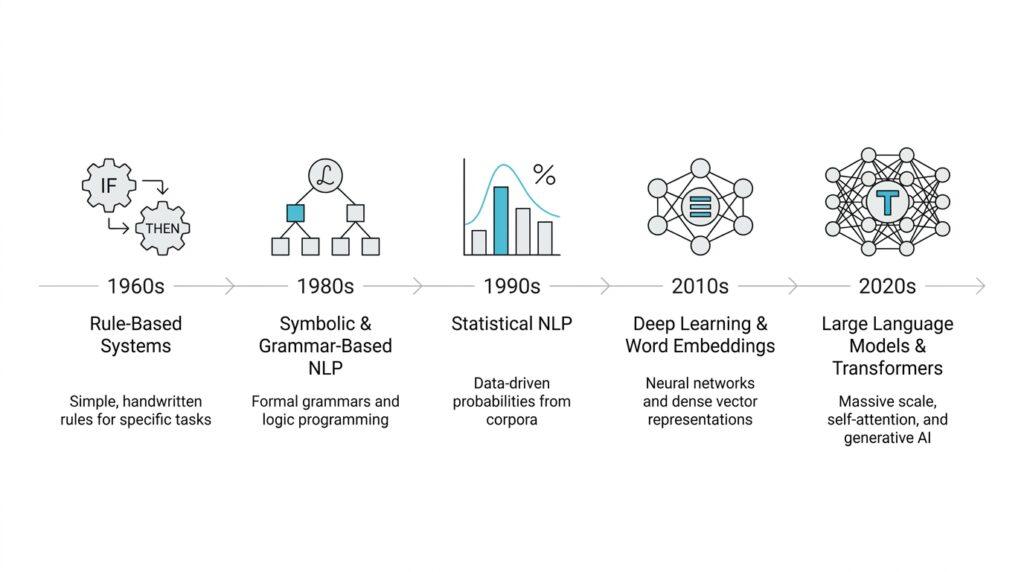
Rule-Based Beginnings
If you’ve ever wondered how a machine could understand language before modern models learned from mountains of text, the answer begins with rule-based NLP. How do you teach a machine to read before it can learn from examples? Early researchers answered that question the way a careful mechanic answers a broken engine: by opening the hood, naming every part, and writing down the rules that tell each part what to do. Symbolic NLP in this period leaned on formal language, grammar, and explicit instructions rather than statistical guesses.
In practice, that meant language was treated like a giant instruction manual. Early machine translation systems used large collections of hand-written rules to convert words and structures from one language into another, with programmers trying to anticipate grammar patterns and exceptions one by one. It was patient, meticulous work, a little like building a bridge plank by plank while already knowing people will soon try to cross it. The reward was control: if a sentence behaved badly, you could inspect the rule that handled it. The cost was that every new pattern had to be invented by hand.
One of the clearest early examples was ELIZA, the 1966 program by Joseph Weizenbaum. ELIZA used keyword substitution and scripted responses to mimic a Rogerian psychotherapist, which made it feel surprisingly alive to many users. That is part of why ELIZA still matters: it showed that a short set of rules could create a strong illusion of understanding, even when the system was doing little more than spotting cues and swapping phrases. In other words, the surface of conversation can look intelligent long before the machinery underneath truly is.
A few years later, SHRDLU pushed rule-based NLP even further. Built by Terry Winograd, it operated in a tiny “blocks world,” where the program could move objects, follow commands, and answer questions about that limited environment. This was not general language understanding; it was understanding inside a carefully fenced garden, where every object, action, and relationship had already been defined. Still, the system was a landmark because it combined syntax, semantics, and world knowledge in a way earlier chat-style programs had not. Rule-based NLP could do more than reply; it could reason, as long as the world stayed small enough.
That small world was also the clue to the approach’s limits. A 1969 survey of natural-language question-answering systems concluded that researchers had found only minimally effective techniques for small experimental systems, and warned that moving to larger grammars and semantic systems would require something fundamentally different. This is the tension that keeps showing up in early NLP: the rules work when the domain is narrow, but language itself keeps slipping beyond the fence. Ambiguity, exceptions, and context are not edge cases in human speech; they are the normal weather of it.
So the rule-based beginning gave NLP its first real shape. It taught researchers to think in terms of grammar, structure, and explicit meaning, and it produced systems that were understandable in a way many later models were not. But it also revealed the central problem that would drive the field forward: human language is too flexible to be captured cleanly by hand alone. Rule-based NLP gave us the map, the compass, and the first trail markers, and then it quietly showed us how much farther the landscape still stretched.
Statistical NLP Takes Over
What made statistical NLP different from the rule books we just left behind? It began when researchers stopped asking a programmer to anticipate every sentence and started asking a corpus—a large collection of real text—to reveal the patterns for us. In statistical NLP, a model assigns probabilities, which are numbers that describe how likely something is, to word sequences and tagging choices so it can pick the most plausible path instead of the manually scripted one. That shift showed up early in machine translation, speech recognition, and tagging work, where IBM researchers argued that large machine-readable corpora and faster computers made a statistical approach practical at last.
A language model is easiest to picture as a weather forecast for words: it does not promise certainty, but it tells us what is likely to come next. The most familiar version is an n-gram model, where an n-gram is a short sequence of words, such as a pair or trio, and the model predicts the next word from the recent ones. Brown and colleagues pushed this idea further by grouping words into classes based on how they behave in text, which let the model generalize beyond exact phrases. The catch was that real language always throws in surprises, so smoothing became essential; smoothing means giving a small amount of probability to rare or unseen sequences instead of letting them collapse to zero.
Once that logic settled in, it moved straight into part-of-speech tagging, the task of labeling each word as a noun, verb, adjective, or similar category. Here the breakthrough was the hidden Markov model, a probabilistic model that treats the true tags as hidden states and the observed words as the clues we can see. Cutting, Kupiec, Pedersen, and Sibun built a tagger around that idea and reported that it needed only a lexicon and unlabeled training text, while still exceeding 96% accuracy. That mattered because it turned tagging into a learning problem: instead of hand-writing a rule for every ambiguous word, we let the model learn from context and then choose the most likely tag.
You can see the same change in machine translation. In 1990, Brown and colleagues argued that earlier statistical translation ideas had stalled mainly because computers were weak and machine-readable text was scarce, not because the approach was flawed. Their paper framed translation as a probability problem over sentence pairs, which was a very different mindset from the handcrafted rule systems that came before. A year later, Jelinek and colleagues described a dynamic language model for speech recognition, and by 1996 Chen and Goodman were studying how smoothing choices affected n-gram language models across different corpora and data sizes. What changed was the center of gravity: language processing started to feel less like writing a law and more like ranking possibilities.
That said, statistical NLP did not erase rules overnight. Miller and colleagues still noted in 1996 that many systems remained primarily rule based, even when they borrowed statistical pieces, because some problems were too messy to hand over to counts alone. But the direction was unmistakable: data was now doing work that grammar books used to do by hand. For readers coming from the rule-based era, this is the key shift to hold onto—statistical NLP was not just a new toolkit, it was a new habit of thought, one that trusted patterns in text to carry the load when language refused to stay neat.
Word Embeddings Arrive
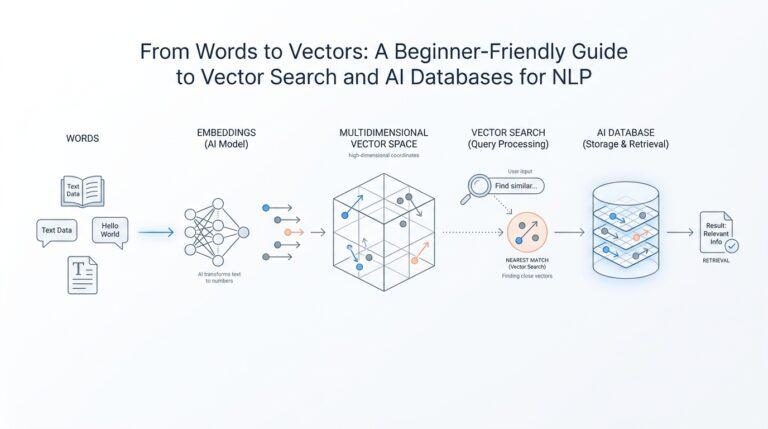
What does it mean for a word to have a position in space? When word embeddings arrive, we stop treating words as isolated labels and start treating them as learned coordinates, each one shaped by the company it keeps. That idea was already taking shape in Bengio’s 2003 neural probabilistic language model, which used a distributed representation for each word to fight the curse of dimensionality, but Mikolov and colleagues made the approach practical at large scale by showing that high-quality word vectors could be learned efficiently from billions of words. In other words, the field had found a way to let language sketch its own map.
That map mattered because it let similar words share statistical strength. Instead of memorizing every sentence pattern by hand, embeddings learn that words appearing in similar contexts should live near one another in vector space. GloVe, short for Global Vectors for Word Representation, made this intuition explicit: it learned from word-word co-occurrence counts and aimed to produce vectors with meaningful internal structure, while also combining the strengths of global matrix factorization and local context-window methods. For a newcomer, the easiest picture is a neighborhood rather than a dictionary: related words do not become identical, but they move closer together.
What did this look like in practice? Word2vec-style models made the geometry useful enough to feel surprising. Mikolov et al. introduced the continuous bag-of-words, or CBOW, model, which predicts the current word from its surrounding context, and the skip-gram model, which predicts surrounding words from the current word. Their paper reported that these models learned from large corpora much faster than earlier neural approaches, with high-quality vectors trained from a 1.6-billion-word dataset in less than a day, and that the resulting vectors improved on syntactic and semantic similarity tests. This was the moment word embeddings stopped being a promising idea and started behaving like a practical tool.
The most striking payoff was that the vector space began to encode relationships, not just similarity. Mikolov’s paper showed that simple vector arithmetic could capture analogies such as king minus man plus woman landing near queen, and GloVe later argued that these regularities emerge from the structure of co-occurrence ratios. That is a subtle but important shift: we were no longer asking a model only whether two words looked alike, but whether their positions captured grammatical and semantic patterns. Once that worked, embeddings became useful features for tasks as different as named entity recognition, parsing, question answering, and document classification.
If you are wondering why this mattered so much, the answer is that word embeddings changed the unit of learning. Earlier systems had leaned on explicit rules or on sparse counts, but embeddings let the model learn a reusable representation that many later systems could build on. GloVe’s authors even framed word vectors as a foundation for future NLP applications, and the broader literature quickly treated them that way. That foundation would soon support richer neural models, but before we move on, it helps to sit with this step: language had become geometry, and geometry gave NLP a new way to generalize.
Seq2Seq Meets Attention
By the time we reached word embeddings, language had become a kind of map. The next problem was harder: how do we move from a map of words to a map of whole sentences? That is where seq2seq, short for sequence-to-sequence, enters the story. In a seq2seq model, one neural network reads an input sequence, such as a sentence in French, and another neural network writes an output sequence, such as the translation in English. This became a turning point for neural machine translation because it let the model learn translation as a single end-to-end task instead of stitching together separate parts by hand.
The first version of seq2seq felt elegant, almost like packing a suitcase for a long trip. An encoder is the part that reads the input and compresses it into a hidden state, which is a learned summary inside the model. A decoder is the part that turns that summary back into words, one step at a time. Early systems often used a recurrent neural network, or RNN, which is a neural network that processes text in order, and many used LSTM units, or long short-term memory units, because they handled longer dependencies better than plain RNNs.
At first, that setup seemed powerful enough to solve translation. Then the hidden-state bottleneck showed up. If the encoder must squeeze an entire sentence into one fixed-size vector, it is a little like asking someone to remember a whole conversation by holding one note card behind their back. Short sentences might survive the journey, but longer ones lose details, and the decoder has to guess too much from too little. This was the central weakness of early sequence-to-sequence models: the architecture could move from one sequence to another, but it still had to carry the entire message in a single compressed memory.
So researchers asked a very practical question: what if the decoder could look back while it was writing? That question led to the attention mechanism, a method that lets the model assign different importance to different input words at each output step. Instead of relying only on one summary vector, the decoder receives a changing set of weights, which are scores showing where to focus. If you want the plain-language version, attention works like a spotlight moving across a page, lighting up the parts that matter most right now.
That small change transformed seq2seq with attention from a clever idea into a much stronger system. When the model translated a word like “bank,” attention could look at nearby context and decide whether the sentence was talking about money or a riverbank. When it handled a longer sentence, it no longer had to trust a single squeezed representation to preserve every detail. The result was better alignment between input and output, which made translations more accurate, more fluent, and often more interpretable than before. In practice, you could sometimes inspect the attention weights and see which source words influenced each generated word.
If you are wondering, “Why did attention matter so much if the model already had embeddings and a decoder?”, the answer is that it changed how memory worked. Word embeddings gave the model useful representations, but attention gave it selective recall. Instead of remembering everything equally, the model could choose what to inspect at the right moment, much the way we reread a specific line in a recipe instead of memorizing the whole page. That flexibility helped seq2seq models spread beyond translation into tasks like summarization, speech recognition, and question answering, where the output also needs to follow the structure of an input sequence.
What we learn from this stage is that neural machine translation did not improve by making one giant leap. It improved by solving a very human problem: how to keep track of what matters while language unfolds over time. Seq2seq gave NLP the basic choreography for turning one sequence into another, and attention gave it the instinct to look back at the right moment. Together, they made sequence modeling feel less like compression and more like conversation, which is exactly the kind of shift that would prepare the field for even larger and more flexible neural systems.
Transformers Redefine NLP
Now that attention has entered the story, the next leap feels almost inevitable: transformers take that idea and build an entire model around it. If you’ve been wondering, what is a transformer in NLP? the short answer is that it lets every word look at every other word at the same time, instead of forcing language through one step after another. That matters because natural language processing works better when the model can compare distant words, and the original Transformer showed that this design could beat earlier sequence models on translation while training much faster.
The easiest way to picture a transformer is as a room full of people passing notes. Each token, which is a piece of text such as a word or subword, sends and receives information from the others through self-attention, a mechanism that tells the model which words matter most right now. Because attention alone does not know where a word sits in a sentence, the model also uses positional encoding, a signal that tells it the order of the tokens. That combination gives transformers a kind of flexible reading strategy: they do not march through a sentence like a line of dominoes, but they still keep track of sequence.
That design changed the speed of NLP as much as its accuracy. In the original paper, the Transformer reached strong results on machine translation tasks and did so with far better parallelization, which means the model can process many tokens at once instead of waiting for the previous step to finish. For beginners, that difference is a little like moving from reading a book one word at a time with a flashlight to scanning whole pages under bright lights. Once you can train faster and handle long-range relationships more cleanly, the transformer model stops being a clever experiment and starts becoming a practical default.
The real turning point came when transformers began to learn from huge amounts of unlabeled text, which is text that has not been manually annotated with tags or answers. BERT, short for Bidirectional Encoder Representations from Transformers, pre-trains deep bidirectional representations by looking at both the left and right context of each word, then fine-tunes that knowledge for a specific task with only a small task layer added on top. In plain language, BERT taught NLP that one strong language engine could be reused across question answering, inference, and classification instead of rebuilding a new system for each job.
A similar idea pushed the field even further: instead of treating different tasks as separate puzzles, some transformer models began to treat everything as text in, text out. T5, the Text-to-Text Transfer Transformer, framed translation, summarization, and classification inside one unified text-to-text setup, which made transfer learning feel much more natural. Then GPT-3 showed that scaling a transformer language model to 175 billion parameters could produce strong few-shot performance, meaning the model could tackle a new task from only a few examples without gradient updates or task-specific fine-tuning. That was a striking sign that transformers were no longer just good encoders or decoders; they were becoming general-purpose language machines.
So when people say transformers redefine NLP, they mean more than a jump in benchmark scores. They mean that the field shifted from handcrafted pipelines and narrow statistical tricks toward large, reusable models that learn from broad text corpora and transfer that knowledge across tasks. For us, that change is the bridge between earlier neural sequence models and today’s large language models: the transformer turned context into a first-class resource, and once that happened, scale, pretraining, and flexible prompting could do the rest.
Scaling and Alignment
If transformers gave NLP a new engine, scaling and alignment taught that engine how to travel farther and drive more safely. This is the moment when large language models stopped feeling like clever text predictors and started feeling like assistants you could actually work with. The big question became: why does scaling matter for large language models, and how do we make them follow what people really mean?
Scaling changed the field because researchers noticed a simple but powerful pattern: when you give a model more parameters, more data, and more compute, its performance often improves in predictable ways. A parameter is a learned number inside the model, and compute is the raw processing power needed to train it. That insight turned model building into a resource problem as much as a design problem, like asking not only how to build a better bicycle, but how much metal, time, and workshop space we can afford to put into it.
At first, the language models behind this shift were still doing one humble job: next-token prediction, meaning they learned to guess the next piece of text from the pieces before it. Yet when we scaled that training up, something surprising happened. The model did not just become better at autocomplete; it began to pick up patterns for reasoning, translation, summarization, and question answering as if those skills had been hiding in the same training signal all along. That is why the phrase large language models became so important: the size was not decoration, it was part of the capability.
But bigger models alone do not automatically become helpful companions. A model can be fluent and still wander off course, answer too vaguely, or produce harmful output. That is where alignment comes in, which means shaping the model’s behavior so it matches human intent, useful norms, and safety expectations. In plain language, scaling makes the model stronger, while alignment makes it more trustworthy. If scaling is the horsepower, alignment is the steering wheel and brakes.
The first major alignment step for many systems was supervised fine-tuning, often called SFT. Fine-tuning means taking a pre-trained model and training it a bit more on curated examples, such as prompts paired with good answers. This stage teaches the model what a helpful response looks like in practice, especially when a user asks for something more specific than the raw pretraining data ever made clear. It is a bit like moving from reading every book in a library to practicing with an experienced tutor who circles the kinds of answers we should give.
Then came reinforcement learning from human feedback, or RLHF. Reinforcement learning is a training method where a model learns from rewards, and human feedback means people judge which outputs are better. In the language model setting, humans compare responses, the model learns which kinds of answers people prefer, and the system gradually shifts toward being more useful, polite, and on-task. This was a turning point for alignment because it connected technical training directly to human preference, not just statistical likelihood.
As models grew larger, alignment also became more visible in everyday use. A scaled model might know many facts, but without alignment it can still ramble, hallucinate, or ignore the user’s request. With better alignment, it becomes easier to guide the model through prompts, role instructions, and task constraints, which is why modern large language models often feel less like raw prediction engines and more like conversational partners. The difference is not magic; it is the result of training the model to care about response quality, instruction-following, and safety alongside linguistic fluency.
What makes this stage so important in the story of NLP evolution is that it connects power with responsibility. Scaling gave models breadth, depth, and emergent skill, while alignment taught them how to use those abilities in human-facing settings. Once those two ideas came together, the field stopped asking only, “Can the model generate the next word?” and started asking, “Can it generate the right word, for the right reason, in the right context?” That shift is what turned transformers into the modern systems we now call large language models.